Most visitors arrive at Mission Nombre de Dios for the cross. They photograph it against the sky, walk back to the parking lot, and move on. That is a reasonable way to spend fifteen minutes at one of the most historically compressed sites in North America - but it misses everything. What looks like a waterfront garden in St. Augustine holds the layered record of a Timucuan pottery center, the first Catholic Mass celebrated in the continental United States, the first permanent European Christian settlement in what is now the country, the oldest Catholic congregation on American soil, four cycles of destruction and rebuilding over two centuries, a Cold War church dedicated to prayer against nuclear warfare, and ongoing university archaeology that keeps finding the physical bones of Pedro Menéndez de Avilés's 1565 fort under the lawn. This guide works through all of it.
The Sacred Acre: What You Are Standing On
The Diocese of St. Augustine designates the area around the Rustic Altar the "Sacred Acre" - its term for the ground believed to mark the precise location of the September 8, 1565 Mass. That designation is doing a lot of historical work in a small space.
Before any European set foot here, this was Seloy, a Timucuan village with an established economy built on pottery and tool-making. The Timucua were not a scattered hunting band; they had permanent structures including a large council house that Menéndez would shortly convert into a fort. When the Spanish fleet anchored off this shore, they were not landing on a wilderness clearing - they were landing in the middle of someone's town.
What accumulated here in the decades and centuries that followed makes the site arguably the single most historically dense acre of ground in the United States:
- The first documented Catholic Mass in the continental United States - September 8, 1565
- The first permanent European settlement in what is now the continental US, predating Jamestown by 42 years
- The formal founding of the first permanent Christian mission in the continental US - established by Franciscan missionaries in 1587, a full 22 years after the initial Mass
- The first permanent shrine to the Virgin Mary in the continental US, built in 1687
- The oldest Catholic congregation in continuous existence in the United States
- The site of what the National Park Service identifies as the first American Thanksgiving - the shared meal between Menéndez and the Seloy tribe on the afternoon of September 8, 1565
A statue of Father Francisco López de Mendoza Grajales stands near the Rustic Altar. The Diocese recognizes him as the first parish priest in the continental United States - a title that carries more weight when you understand the full sequence of what happened here.
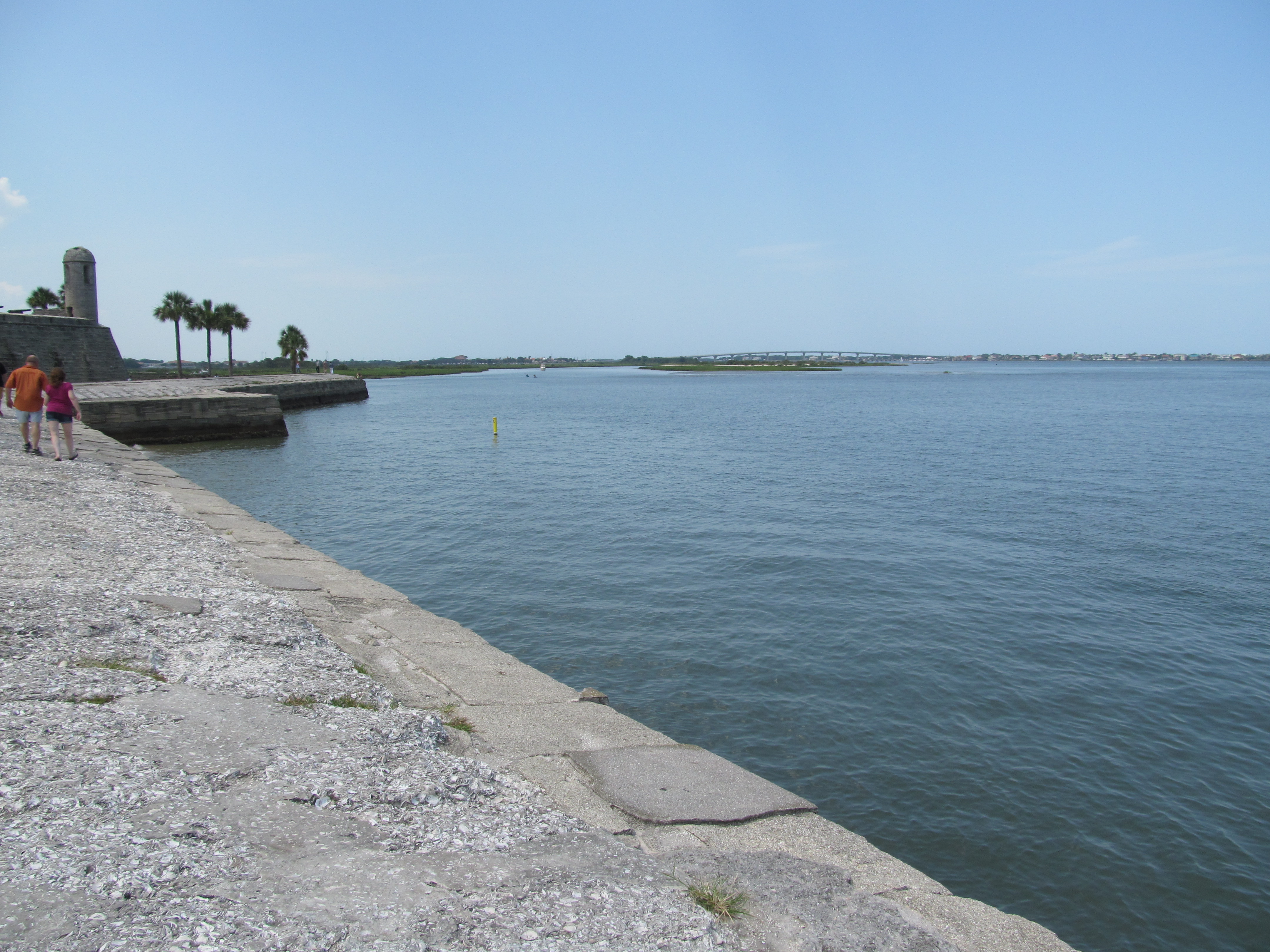
September 8, 1565: The Landing, the Mass, and the First American Feast
The date was not random. Menéndez held his fleet offshore and waited for the Catholic feast of the Nativity of the Blessed Virgin Mary to celebrate his landing - a deliberate choice that stamped religious intent onto the founding act from the first moment. Father López de Mendoza Grajales, the expedition's chaplain, went ashore with the first boats. His own written account preserves the sequence.
- Menéndez waded ashore at Seloy while the ships' crews sang the Te Deum in his honor
- Father López celebrated Mass on the beach - the first Catholic Mass in what is now the continental United States
- Menéndez formally took possession of the land for Spain and named the settlement St. Augustine
- Menéndez laid out a meal and invited the Seloy tribal leaders to eat with the Spanish colonists
- Menéndez then moved into the Timucuan council house and converted it on the spot into a Spanish military fortification
That post-Mass meal is the event the National Park Service identifies as the first American Thanksgiving - predating the 1621 Plymouth harvest feast by 56 years. The comparison is not universally accepted by historians, who note the different peoples, faith traditions, and political circumstances involved. What is not disputed is the documented sequence: a Mass, a shared meal between Spanish colonists and Timucuan leaders, and an immediate military occupation of the host community's council house - all on the same afternoon.
That last step matters. This was not a site that started as a mission and later became militarized. It was a fort and a church from the same afternoon, and that dual identity runs through every phase of the site's history for the next 160 years.
From Council House to Franciscan Mission: 1565-1702
A persistent confusion in visitor accounts blurs two distinct events separated by 22 years. Menéndez's chaplain celebrated Mass here in 1565, but the formal establishment of Mission Nombre de Dios as a Franciscan institution did not happen until 1587. These are not the same thing, and the difference matters to understanding the site's claim to multiple "firsts."
The 1565 Mass marked the founding of St. Augustine and established a Spanish Christian presence on the site. The 1587 Franciscan founding marked the formal installation of missionaries as a permanent religious order operating the first institutional mission in what is now the continental US. Both events are genuinely significant; they are simply different events, and the site's layered claims rest on keeping them distinct rather than fusing them into a single founding moment.
In 1687, the Governor of Florida commissioned the first permanent shrine to the Virgin Mary in the continental US on the mission grounds. It was dedicated to Nuestra Señora de la Leche y Buen Parto - Our Lady of the Milk and Safe Delivery - a Marian devotion with deep roots in the Spanish Catholic tradition, invoking Mary's protection for childbirth and nursing mothers. The La Leche chapel drew pilgrims from the earliest years of its existence, a tradition that has never fully stopped.
Burned, Rebuilt, and Blown Up: The Mission's Four Destructions
Few religious sites in the United States have been destroyed and rebuilt as many times as this one, and one of those destructions was self-inflicted.
In 1702, British South Carolina Governor James Moore led a siege of St. Augustine. His forces - English soldiers and Yamasee allies - burned the mission buildings at Nombre de Dios. More specifically, Moore's troops used the La Leche church as a firing platform to bombard the Spanish fortifications. The site's elevated ground with sightlines toward the Spanish defenses had made it a military asset as much as a sacred one.
The shrine was rebuilt around 1706, with a Franciscan friary added to the complex. That rebuilding lasted 22 years.
In 1728, British Colonel John Palmer led a raid on the Florida missions. When his force approached, the Spanish made a stark calculation: the La Leche chapel sat on ground with direct sightlines toward Castillo de San Marcos. Rather than allow British forces to use it as an artillery platform a second time, the Spanish blew up the entire complex themselves. This is a historically unusual act - the deliberate demolition of a Marian shrine of 41 years' standing, ordered by its own defenders as a military measure - and it speaks directly to the dual fort-and-church identity the site had carried since the afternoon of September 8, 1565.
The chapel sat in ruins for most of the following century and a half. Bishop Augustin Verot oversaw a rebuilding in 1875; the current shrine building dates to that reconstruction, with a further restoration completed in 1915. What visitors see today as the Historic Chapel reflects that late 19th-century work, not the colonial-era original.
The Great Cross: 208 Feet of Stainless Steel
The Great Cross was erected in 1965-66 as a statement about the 400th anniversary of Menéndez's landing. At 208 feet tall and 70 tons in weight, sheathed in 200 individual stainless steel panels, it was designed by sculptor Eugene Kennedy Jr. Its scale is a 400th-anniversary gesture; its engineering is something most guides overlook entirely.
The specific problem the engineers faced was Florida weather. A 208-foot steel structure on the Atlantic coast sits in the path of major hurricanes, and the wind loads such storms generate can topple structures far more massive than a hollow cross. The solution was to fill the lower 65 feet of the cross solid with concrete - creating a foundation mass heavy enough to anchor the structure against hurricane-force winds. That detail is why the cross has survived on a coastline that has taken direct hurricane hits since its installation.
The cross is illuminated at night and visible from the Matanzas Bay waterfront and from several points along the heritage corridor. It has become the dominant visual identifier of the site for the obvious reason - it is simply that tall. But the cross itself arrived in 1965-66; the site it stands on is 460 years older.
The Prince of Peace Votive Church: A Cold War Artifact on Sacred Ground
Built in 1965 for the mission's 400th anniversary, the Prince of Peace Votive Church is easy to walk past without understanding what it is or why it exists.
It is the only votive church in the Diocese of St. Augustine and one of a small number of votive churches in the entire United States. A votive church is not a parish church. It is a building erected in fulfillment of a specific vow or dedicated to a specific intention - in this case, prayers against nuclear warfare. The church was consecrated during one of the most anxious decades of Cold War tension, three years after the Cuban Missile Crisis brought nuclear confrontation to within 90 miles of the Florida coast. The dedication to peace against nuclear destruction was not abstract theology in St. Augustine in 1965.
That Cold War context is entirely absent from every published visitor guide to the site. What most guides describe as a chapel on the mission grounds is in fact a formal theological response to the nuclear age, placed at the oldest Christian mission in America and dedicated to a cause that felt acutely immediate to the people who built it.
What the Archaeologists Keep Finding
University of Florida archaeologists led by Dr. Kathleen Deagan have excavated the Nombre de Dios site since the 1980s. The findings have consistently closed the gap between founding mythology and physical evidence in ways that mainstream visitor coverage has never reported.
The most significant discoveries to date include:
- A 16th-century moat consistent with the defensive perimeter of Menéndez's initial fortification
- A lime kiln - evidence of the construction activity required to build a permanent Spanish colonial settlement rather than a temporary encampment
- Two massive postholes with intact postmolds dating to the 1560s, interpreted as the structural supports for Menéndez's blockhouse or watchtower - the earliest known Spanish fortification in Florida
Those postholes deserve particular attention. Postmolds are the organic stains left in soil after a wooden post decays in place over centuries. Finding two of them at scale, dating to the 1560s, at the site where historical accounts place Menéndez's first fortification, is not circumstantial. It is physical confirmation that the written record of the 1565 landing corresponds to actual construction on this precise ground.
The story typically told at Nombre de Dios is a documentary one - what written sources say happened here. The Deagan excavations add a physical layer: what the ground itself confirms, four and a half centuries after the fact.
The National Shrine of Our Lady of La Leche: History and Meaning
The National Shrine of Our Lady of La Leche has the most complicated institutional history of any element on the grounds. The original 1687 shrine was destroyed in 1702, rebuilt around 1706, destroyed again by its own builders in 1728, rebuilt in 1875, restored in 1915, and elevated to official national shrine status by the U.S. Conference of Catholic Bishops in October 2019.
That 2019 USCCB designation is significant and largely unreported in visitor coverage. National shrine status under the USCCB framework means the site has been formally recognized as one of the most important Catholic pilgrimage destinations in the United States - a designation held by a small number of sites nationwide. It is not a marketing title; it reflects the USCCB's formal acknowledgment of the site's historical primacy as the first permanent Marian shrine established in the continental US.
Pilgrims still come to La Leche for the original purpose: prayers for safe childbirth, fertility, and the protection of mothers and infants. The 1687 dedication to Nuestra Señora de la Leche y Buen Parto - Our Lady of the Milk and Safe Delivery - remains the shrine's specific Marian focus, unchanged across three and a half centuries of destruction and rebuilding.
Visiting Mission Nombre de Dios: Practical Guide and Heritage Corridor Connections
On the grounds
Admission to the entire grounds is free. The Pilgrim Center, Historic Chapel, Shrine Church, Museum and Gift Shop are open daily; the grounds are open from dawn to dusk. The site is on San Marco Avenue in St. Augustine - confirm current hours and any seasonal adjustments directly on the shrine's official website before visiting, since hours can shift around religious observances and high-attendance periods.
Allow at minimum 90 minutes to cover the site properly. A rushed visit hits the Great Cross and the La Leche shrine. A thorough visit adds the Prince of Peace Votive Church, the Sacred Acre and Rustic Altar, the statue of Father López, and the museum exhibits covering the Deagan excavations with artifact displays.
What not to miss
- The Sacred Acre and Rustic Altar - the Diocese-designated location of the 1565 Mass, with the statue of Father López nearby
- The Prince of Peace Votive Church interior, where the Cold War nuclear-warfare dedication is spelled out in the building's own text
- The Historic La Leche Chapel - the 1875 structure that replaced the colonial original destroyed and self-demolished twice
- The museum exhibits on the Deagan archaeology - the moat, lime kiln, and postmold findings give the founding story physical grounding. Active excavation is not permanently on display since fieldwork has been conducted in phases since the 1980s rather than as a continuous dig; check with the Pilgrim Center on arrival for whether any active work is underway during your visit.
- The Great Cross at dusk, when the illumination makes the hurricane-engineering logic of its concrete base visible in the way the cross meets the ground
Heritage corridor connections
Nombre de Dios sits at the northern anchor of a dense cluster of 1565-era sites. The sequence below builds a coherent arc of the Spanish founding period for heritage corridor travelers.
| Site | Distance from Nombre de Dios | Primary focus | Time needed |
|---|---|---|---|
| Fountain of Youth Archaeological Park | Under half a mile north, walkable | Archaeology of the Seloy village; Timucuan burial grounds | Longer than half a day |
| Castillo de San Marcos | Under 1 mile south, walkable | Spanish colonial military architecture; the fort that survived every siege | 2-3 hours |
| Colonial Quarter | Under 1 mile south, walkable | Living history of 16th-18th century Spanish colonial life | 1-2 hours |
| Fort Matanzas National Monument | Roughly 14 miles south | Inlet fort; site of the 1565 Matanzas massacres of French Huguenots | Half day with ferry crossing |
The Fountain of Youth Archaeological Park is a logical first stop before Nombre de Dios because it excavates Seloy itself - the same Timucuan village where Menéndez landed. Visiting it first puts the community that inhabited this ground before the Spanish into proper focus. Fort Matanzas requires a ferry crossing and a drive south but completes the 1565 story: the September massacres of French Huguenots at Matanzas Inlet happened just weeks after the founding Mass at Seloy, and the two events are inseparable as the full context of Menéndez's campaign to establish Spanish Florida.
The 1565 Mass at Seloy, the first American Thanksgiving feast, the 1587 Franciscan founding, the 1687 La Leche shrine, and the ongoing Deagan archaeology are five separate layers of significance on the same acre of ground. Understanding each one separately makes the site larger, not smaller.