Drive south alongside the Florida East Coast Railway through Bunnell and, if you know where to look, the milepost markers carry a clue about what this corridor once was. Somewhere just north of town the numbers jump from 67 to 86.4. There is no track between those two posts - not anymore. The missing miles mark a slot in the map where the FEC's original mainline used to run, looping inland through pine flatwoods and citrus groves past communities named Espanola, Korona, and Dupont. In 1925 the railroad cut a long diagonal shortcut that made those miles obsolete. The towns along them followed. Two of those communities left National Register landmarks that a driver on the Heritage Crossroads can reach today. Understanding why those landmarks are there - and why nothing else is - starts with that gap in the milepost sequence.
The Gap in the Numbers
Railroad mileposts measure cumulative distance from a fixed origin point. On the FEC, that origin is Jacksonville. When the railroad rebuilt its main line in 1925, it renumbered the route to reflect actual miles on the new, shorter alignment. The problem for anyone reading that sequence at Bunnell is the jump: milepost 67 lies somewhere to the north, milepost 86.4 sits at Bunnell itself, and the numbers between those two do not exist on any operating track.
They existed once. The original FEC mainline did not run straight toward Miami the way modern trains do. It swung inland through East Palatka and then curved south again through a string of small communities before reaching Bunnell. That route was longer, and the railroad eventually replaced it with a more direct line. The rails between Bunnell and San Mateo were pulled up shortly after the new route opened. The milepost numbering was recalculated for the new alignment. The old communities were left in the former corridor without service. The gap from 67 to 86.4 is the arithmetic residue of that decision - visible to anyone paying attention, explained almost nowhere along the road.
Henry Flagler's Inland Route
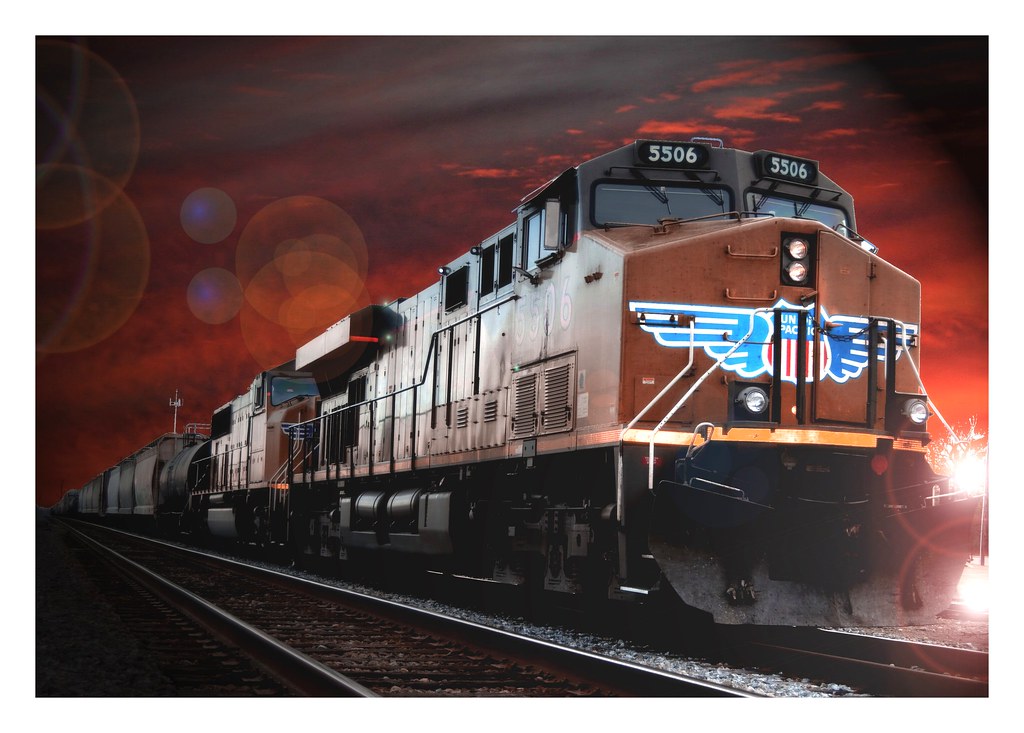
Henry Flagler did not build the railroad that first crossed what is now Flagler County - he bought it. The St. Johns and Halifax Railway had connected East Palatka to Daytona by 1886, running a narrow-gauge line through the pine flatwoods of the interior. Flagler acquired the Jacksonville, St. Augustine and Halifax Railroad, and by spring 1889 his system offered service from Jacksonville south to Daytona, incorporating the earlier line's inland route.
The route swung inland for reasons that made sense given the terrain and technology of the 1880s. The low barrier islands, tidal marshes, and brackish wetlands along the Atlantic coast between St. Augustine and present-day Flagler Beach made a direct coastal alignment expensive and structurally complicated. Inland, the ground was drier and the grades were workable. The coastal alignment that travelers today consider the natural path for a railroad actually required decades of additional infrastructure investment before it became viable for heavy trains.
The practical consequence was that the FEC created settlement where almost none had existed. The railroad preceded the county by nearly thirty years, and the communities it drew into existence - Espanola, Korona, Dupont, Favoretta, Codyville - had no economic rationale except the track running through them. That dependence left them with no leverage when the route changed.
Espanola: A Full Town in the Flatwoods
By the early 1900s, Espanola had built the kind of institutional variety that signals a community expecting permanence. A settlement of roughly a hundred residents, it supported an interlocking set of commercial and civic services:
- Hotel and rooming house for travelers and workers
- Post office and regular mail route
- Cafe and barber shop
- Dry-goods store and grocery
- Automobile garage
- Public school
That is the footprint of a functioning small town - the kind of place where a family living ten miles out could conduct a week's worth of business in a single trip, where a traveling merchant would stay overnight rather than push on. The narrow-gauge St. Johns and Halifax Railway had built through the area around 1884 and Espanola grew in its wake. The community continued to function through the Flagler period as long as the mainline ran through it.
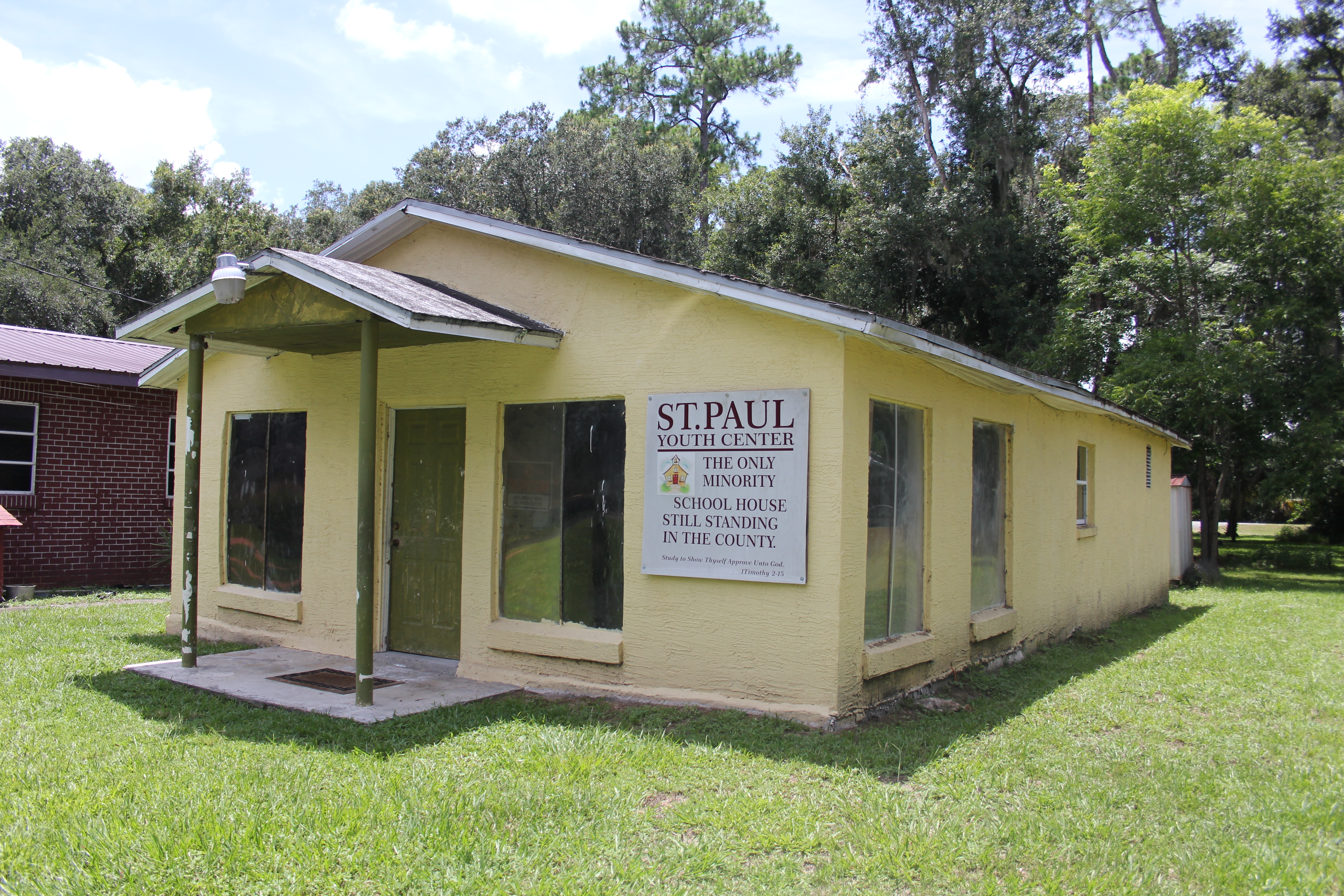
Espanola's African-American residents built their own institutions alongside the broader community. The 1925 cutoff damaged the town, but the Black community maintained its presence in the area for decades afterward. In 1950, teacher Essie Mae Mack Giddens led a fundraising effort built on ice cream sales and peanut sales - small community contributions accumulated into something concrete. The result was a one-room wooden schoolhouse, built by the community itself, that became the Espanola Schoolhouse. It was added to the National Register of Historic Places on July 22, 2020 - the first piece of Flagler County Black history to receive that designation. The building is small and plain, which is part of its meaning: a community that the railroad's departure had already diminished, building its own infrastructure and leaving a physical record that survived long enough to be protected.
Korona: The Crown of the Interior
Korona was not an organic railroad settlement. It was a deliberate founding. In 1914, thirty-five Polish immigrant families from Chicago and Detroit responded to advertisements in the Bunnell Development Company newsletter that promoted affordable farmland in the Florida interior. The families came south, bought their land, and named their community Korona - the Polish word for crown - in honor of the Blessed Virgin Mary as Queen of Poland, the patron saint the founding families invoked as they began their new settlement.
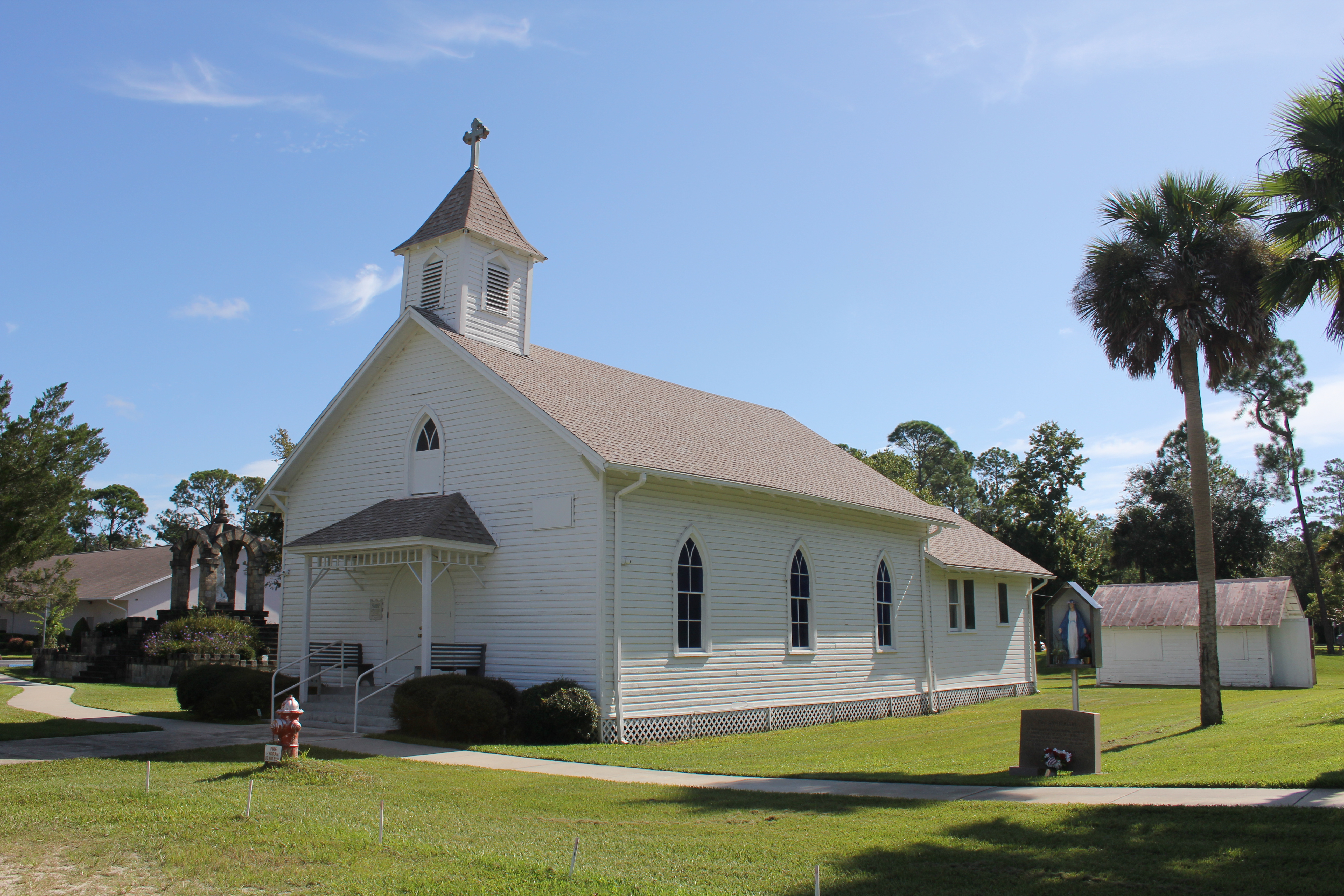
The church was built within the founding year. The settlers raised funds among themselves and constructed St. Mary, Queen of Poland Catholic Church, a Carpenter Gothic wood-frame building that became the center of community life and, as it turned out, the most enduring thing those families built. The church is still standing. Its congregation still offers a weekly Polish-language Mass. On January 25, 2024, the building was listed on the National Register of Historic Places on the basis of its Carpenter Gothic architecture, its ethnic heritage significance, and its importance to the documented history of European immigration into Florida. It is the oldest surviving church building in Flagler County.
Korona's situation after 1925 shows what rail abandonment meant for an agricultural community specifically. The families had come because the railroad made farming economically viable - produce could reach markets, goods could arrive, people could move in and out without prohibitive difficulty. Without the connection, the logic of the settlement unraveled. Korona did not disappear at once, but it stopped growing, stopped drawing new residents, and contracted sharply from whatever modest scale it had reached in its first decade.
Dupont, Favoretta, Codyville: Paper Towns and Mill Towns
Not every community along the inland corridor had Korona's cohesive founding story. Several existed primarily as extraction outposts, organized around the timber industry that the railroad made profitable in the Florida interior.
Dupont offers the sharpest illustration. Its original plat, filed April 30, 1900, laid out more than a hundred city blocks - a land developer's vision of a real city, spread across a legal document with named streets and numbered lots. The town operated a large sawmill, a planing mill, and a stave mill. Lumber moved on the FEC. Workers lived on-site. But the plat's ambition never materialized into actual settlement on any scale approaching the grid it described. The mills worked as long as the rails served them. When service ended, the mills had no economical way to move product, and Dupont disappeared leaving almost no physical trace.
Favoretta and Codyville followed the same pattern. The Flagler County Historical Society records both as communities that declined or vanished directly because of losing rail service after 1925 - not through slow demographic drift, but as a pointed consequence of a single infrastructure decision made by a private railroad in a single year.
The communities including Espanola, Korona, Dupont, Favoretta, and Codyville all declined or disappeared directly as a consequence of losing rail service after 1925.Flagler County Historical Society
The Moultrie Cutoff of 1925
The FEC completed the Moultrie Cutoff in 1925. The line ran from St. Augustine south in a nearly straight diagonal to a connection point just north of Bunnell, bypassing the entire inland loop. The name comes from the Moultrie area near St. Augustine where the new line diverged from the original routing. The operational case for building it was straightforward.
- The new alignment was substantially shorter, reducing running time between Jacksonville and Miami
- The straighter path allowed higher train speeds and lower fuel cost per trip
- A 1926 double-tracking project combined with the cutoff to give the FEC a two-track main line from Jacksonville to Miami, transforming it into a modern Class I railroad
- Freight and passenger capacity increased without requiring new motive power
The FEC was making these investments during Florida's mid-1920s land boom, when demand for freight and passenger service was growing fast and the railroad needed to move more trains on tighter schedules. From the corporation's perspective, the cutoff was the correct engineering response to a clear operational problem.
The communities in the bypassed segment had no input and no recourse. Rails were pulled up between Bunnell and San Mateo almost immediately after the cutoff opened. Within a year, the track bed that had served Espanola, Korona, Dupont, and their neighbors was gone. No freight service, no passenger service, no mail cars. The economic infrastructure those towns depended on ceased to exist in a single calendar year.
U.S. Highway 1 and Why Bunnell Survived
If the Moultrie Cutoff began the consolidation of traffic onto the coastal strip, U.S. Highway 1 finished the job. The federal highway was completed through this part of Florida in 1926 - the year after the cutoff - following the coast rather than the inland route. Commerce, travelers, and development followed the highway east. The inland communities, already without rail service, now sat off the main road network as well.
Bunnell's survival despite being on the original inland route requires explanation. The Moultrie Cutoff rejoined the original mainline at a point just north of Bunnell, which meant that southbound freight trains still ran through Bunnell even after the inland loop to the north was abandoned. The town retained active rail service. It also held county-seat status - a function it had earned precisely because the FEC mainline ran through it when Flagler County was created in 1917. County government, a courthouse, banks, and law offices do not relocate because a railroad adjusts its route miles to the north. Bunnell absorbed the commercial functions that the bypassed towns could no longer serve, and freight trains still pass through it daily on track Flagler first built.
| Community | Founded | Character before 1925 | Outcome after cutoff |
|---|---|---|---|
| Espanola | Around 1884 rail route | Hotel, stores, school, post office | Declined; NRHP schoolhouse survives |
| Korona | 1914, Polish immigrant founders | Agricultural community, active church | Contracted; NRHP church still active |
| Dupont | Platted 1900, timber industry | Sawmill, planing mill, stave mill | Vanished; no structures survive |
| Favoretta | Railroad stop, interior corridor | Small railroad community | Disappeared after 1925 |
| Bunnell | FEC mainline stop, county seat 1917 | County government, rail commerce hub | Survived; county seat, active daily rail |
What Survives: Driving the Heritage Corridor Today
Two National Register properties from the inland corridor are standing, documented, and reachable. One represents the Polish immigrant community that settled beside the FEC mainline in 1914. One represents the African-American community of Espanola that maintained itself through the railroad's departure and built its own school in 1950. They sit in the same interior landscape the original mainline crossed, and the roads between them broadly follow the territory the track once served. Before driving to either site, it is worth knowing what each one preserves:
- St. Mary, Queen of Poland Catholic Church is an intact founding institution - the original building, an active congregation, and a continuous connection to the Polish immigrant community that created it in 1914
- The Espanola Schoolhouse is a record of community self-sufficiency under abandonment - built by residents through their own fundraising after the railroad had already left and the town had already contracted
- Together, the two sites document both the European immigrant story and the African-American history of Flagler County's interior in a single driving loop that most visitors to the Heritage Crossroads never take
Driving the corridor in sequence
- Begin in Bunnell. Note the active FEC freight line running through town. If you find a milepost marker, observe the number - you are near 86.4, and the next milepost to the north will be 67. That gap is the entire story of the inland corridor in two numbers.
- Take State Road 11 north out of Bunnell into the agricultural interior. The road runs through the same flatwoods landscape the original mainline crossed. It is quiet, and the drive itself is the context.
- Turn toward Korona and St. Mary, Queen of Poland Catholic Church. Walk around the building to see the Carpenter Gothic details - steeply pitched rooflines, vertical board-and-batten siding, pointed window forms - that earned its 2024 National Register listing. The congregation holds a weekly Polish-language Mass; check the parish schedule in advance if you want to attend one, though the exterior rewards a stop on any day.
- Continue toward the Espanola area and the schoolhouse - a single-room wooden structure built by community members, not contractors, through the fundraising that teacher Essie Mae Mack Giddens organized in 1950. Confirm current access conditions with the Flagler County Historical Society before arrival; unpaved roads in the area can be difficult after rain, and access may require advance contact.
- Return east to U.S. 1 to rejoin the main Heritage Crossroads route. You have covered the core of the abandoned corridor and seen what the 1925 cutoff left behind.
Frequently Asked Questions
What does the milepost jump from 67 to 86.4 at Bunnell actually mean?
It marks the miles the FEC dropped from its sequence when the 1925 Moultrie Cutoff replaced the inland loop with a shorter, more direct line. Rails on the bypassed segment were pulled up and the count was recalculated; the towns in those missing miles lost service in the same stroke. The Gap in the Numbers section above traces the full chain of events.
Can visitors go inside the St. Mary, Queen of Poland Catholic Church in Korona?
The church is an active parish that holds regular services including a weekly Polish-language Mass, so visiting during a scheduled service is possible. For a weekday visit, calling the parish in advance to confirm access is practical. The exterior, Carpenter Gothic architecture, and grounds are visible and worth examining without entering. The church was listed on the National Register of Historic Places in January 2024 - the National Park Service NRHP database has the full nomination documentation.
Is the Espanola Schoolhouse publicly accessible?
The schoolhouse is a National Register property listed in 2020, but organized public access is managed locally rather than through a standing open-door arrangement. Contact the Flagler County Historical Society before planning a visit to confirm current access conditions and whether advance arrangements are needed. Roads in the area can be rough after rain, so checking conditions beforehand is worthwhile.
Why did Bunnell survive when the other inland towns did not?
The cutoff rejoined the original mainline just north of Bunnell, so the town kept active daily rail service. County-seat status - established in 1917 when the FEC ran through town - gave Bunnell institutional weight that purely commercial railroad stops lacked. The U.S. Highway 1 and Why Bunnell Survived section above covers both factors in detail.
Did any trace of the old railroad route survive?
The rails themselves were removed shortly after 1925 and likely reused elsewhere in the FEC system. Some stretches of the old roadbed remain detectable as subtle linear grade features in the flatwoods - gentle raised straightaways that do not quite match the surrounding terrain. No station buildings or original railroad structures from the bypassed segment are known to survive above ground; the schoolhouse and church survived because they were community buildings maintained by active residents, not because any railroad infrastructure was preserved.
Where can I learn more about the communities that disappeared?
The Flagler County Historical Society holds the most detailed local records on Espanola, Korona, Dupont, Favoretta, and Codyville. The National Register nomination documents for both the St. Mary, Queen of Poland Catholic Church (listed 2024) and the Espanola Schoolhouse (listed 2020) are publicly available through the National Park Service and contain thorough historical documentation on the communities those buildings represent. The Flagler County government's heritage resources contacts can direct visitors to current site access information.