Three hundred years of contested sovereignty, forced labor, sieges, prison terms, and broken promises are embedded in the coquina walls of Castillo de San Marcos. The fort anchors the northern end of the Heritage Corridor - 98 miles of connected history running through Flagler, St. Johns, and Volusia counties - and no single structure on that route carries more of the story. It is the oldest masonry fort in the continental United States. It has never been taken by force. Its arc runs from a pirate raid in 1668 to Apache prisoners arriving by train in 1886. Most visitor guides start at the groundbreaking. This one starts where the story actually begins.
The 1668 Raid That Made the Fort Necessary
Robert Searles and the Last Wooden Fort
On the night of May 28, 1668, English privateer Robert Searles sailed into St. Augustine harbor with 55 men. He found a town with no real defense. Before morning his crew had killed roughly 60 residents, looted homes and warehouses, and sacked the settlement; the governor managed to reach the wooden fort with soldiers and prevent the raiders from seizing it, but could not stop them from plundering the town.
That single raid settled a question the Spanish had been delaying for decades. St. Augustine had been defended by nine successive wooden forts since the city's founding in 1565. Every one had been destroyed - burned, rotted through, knocked apart by storms, or wrecked in raids. The colonial government kept rebuilding in wood because masonry construction was slow and expensive. Searles made the cost of delay impossible to ignore any longer. A man with 55 sailors had walked through a settlement that could not mount an adequate defense.
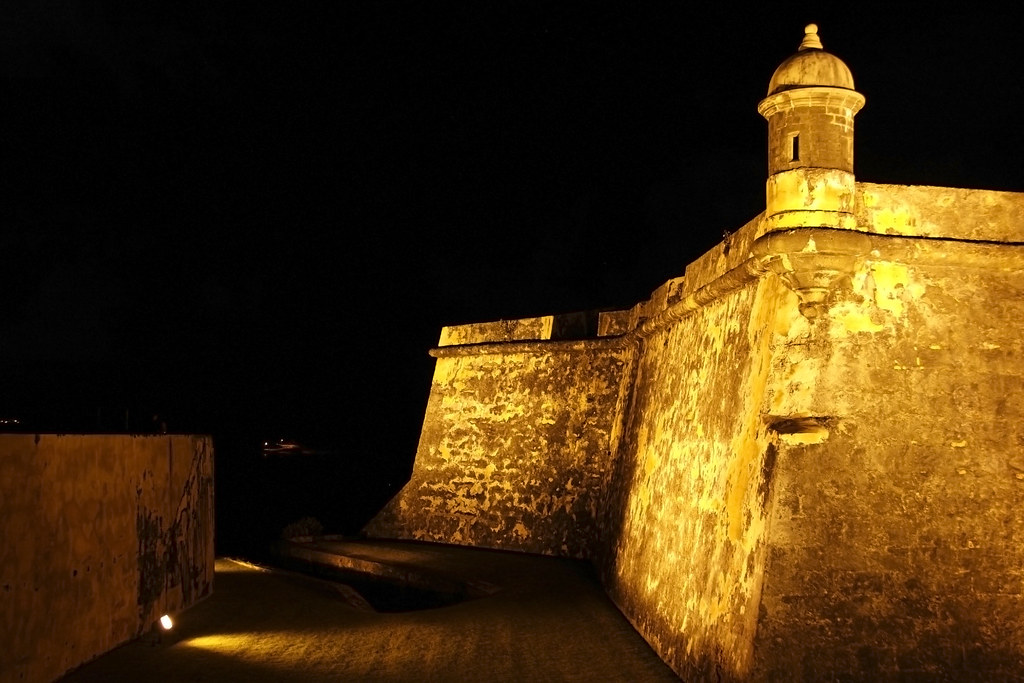
Construction was authorized by the Spanish Crown in 1669. Three years after that, on October 2, 1672, construction began on a permanent masonry fort on the same site. The choice to build from coquina was partly practical and partly a matter of what was available. The construction would take 23 years.
Building It: 23 Years, the King's Quarry, and a Mixed Labor Force
Stone from Across the Bay
Every block in the Castillo came from a single source: the King's Quarry on Anastasia Island, directly across Matanzas Bay from the construction site. That quarry is now inside Anastasia State Park, listed on the National Register of Historic Places, and covered in depth on the Heritage Corridor's Anastasia Island page. Workers quarried more than 150 million pounds of coquina over the course of construction, cut the blocks by hand, and barged them across the bay to the site. There was no other way to move them.
The mortar binding those blocks was made on site by burning oyster shells into lime, then mixing the lime with sand and water. Both the stone and the mortar came from the local bay environment. The fort is, in a literal sense, built from the floor of Matanzas Bay and the shells of creatures that once lived in it.
Who Built the Walls
The labor force was one of the most mixed in colonial North America. It brought together nearly every population group then present in the region:
- Military engineers and stonemasons shipped directly from Spain to direct the technical work
- Convicts transported from Cuba and put to work quarrying and on the walls
- Timucua people from the surrounding region, whose labor the Spanish colonial system routinely conscripted for crown projects
- Enslaved Africans, whose presence connects the Castillo directly to the broader African diaspora history running through the Heritage Corridor
Construction ran from 1672 to 1695 - 23 years that overlapped with drought, disease outbreaks, and continued English pressure from Carolina settlements to the north. The finished walls average 12 feet thick and reach 19 feet on the ocean-facing side. By any standard it was the largest construction project in the history of Spanish Florida.
Why Coquina Won: The Physics of Shell Rock Under Cannon Fire
What Cannonballs Do to the Wrong Kind of Wall
Against hard stone or fired brick, a direct cannonball hit does what attackers want: it shatters the material. Cracks propagate outward from the impact point, chunks fall, and over time a wall develops gaps that infantry can exploit. The whole mechanism depends on the wall being brittle.
Coquina is not brittle. It is porous, loosely cemented shell aggregate with a slight elasticity. A cannonball hitting a coquina wall does not shatter it. The ball punches a shallow crater and stops, its energy absorbed by the surrounding material rather than transferred outward as cracking. After the 1702 siege, an English officer described the effect in a report that has survived.
"The walls will not splinter but will give way to cannon ball as though you would stick a knife into cheese."
English officer's report on the 1702 siege of the Castillo
That officer's commander was Carolina Governor James Moore. Moore arrived in November 1702 with the most serious English attack yet mounted against St. Augustine. He spent roughly seven weeks bombarding the fort while more than 1,500 Spanish colonists sheltered inside. His cannonballs disappeared into the walls. Moore burned the town, failed to breach the fort, and retreated when a Spanish relief fleet appeared in the harbor. The Castillo was eight years old and already proven.
The 1740 Siege and the Battle That Broke It
The second major test came in the summer of 1740. Georgia Governor James Oglethorpe arrived with a substantial combined force and began a siege on June 13. He had more men, more planning, and more time than Moore had brought. Coquina had not changed its properties.
The turning point did not happen inside the Castillo. On June 26, Spanish Governor Manuel de Montiano launched a dawn raid from the fort against a British camp at Fort Mose - the free Black settlement north of the city, covered on the Heritage Corridor's Fort Mose page. That raid killed between 68 and 75 British-allied soldiers and captured 34. It shattered the offensive momentum of the invading force. Oglethorpe held the siege until July 20, then withdrew to Georgia. He never came back. Fort Mose and the Castillo had each contributed something the other could not provide alone, and together they held the peninsula.
Why the Shape Mattered
The fort's star-shaped bastion design was standard European military engineering of the 1600s, chosen for a specific tactical reason: it eliminated blind spots. A rectangular fort left the base of each wall undefendable. Attackers could reach the foot of the wall without anyone inside being able to fire at them. The bastion design solved this in a straightforward way.
- Each projecting diamond-shaped bastion covers the outer face of the two adjacent walls
- Defenders on one bastion can fire laterally along any wall that comes under attack
- There is no position outside the fort that falls out of range of fire from at least one bastion
- Any assault must advance simultaneously under fire from multiple directions, with no safe approach angle
Combined with coquina's energy-absorbing properties, the design made a direct assault essentially impossible with weapons available in the 17th and 18th centuries.
Five Flags, Four Governments: Spain, Britain, the Confederacy, and a Name Congress Erased
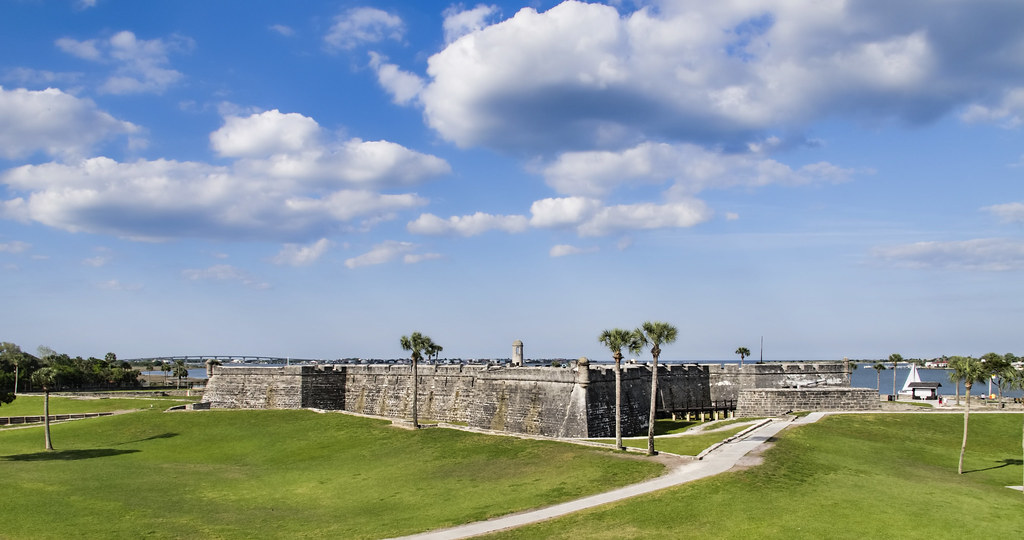
The Castillo changed hands five times over its history. Not once was it taken by force.
| Government | Name Used | Period | How Control Ended |
|---|---|---|---|
| Spain (first period) | Castillo de San Marcos | 1695-1763 | Ceded by treaty after Seven Years' War |
| Britain | Fort St. Mark | 1763-1783 | Returned to Spain by Treaty of Paris |
| Spain (second period) | Castillo de San Marcos | 1783-1821 | Florida ceded to U.S. by treaty |
| United States | Fort Marion (name restored 1942) | 1821-present | Ongoing federal ownership |
| Confederacy | Fort Marion | Jan 7, 1861 - Mar 11, 1862 | Abandoned; Union retook without resistance |
The United States renamed the fort Fort Marion in 1821 when it took possession after the Adams-Onis Treaty. The original Spanish name was gone. It stayed gone for 121 years. Congress passed legislation restoring the name Castillo de San Marcos in 1942 - a correction that took longer than the entire British occupation of the fort had lasted.
The Seminole Prisoners: Osceola, a White Flag, and an Eight-Inch Window
In October 1837, U.S. forces seized Seminole leader Osceola while he was arriving under a white flag of truce for negotiations. He was brought to the Castillo and imprisoned. The use of a truce flag to capture a negotiating party was indefensible by the laws of war at the time and provoked open objection even among some American officers. Osceola died in captivity three months later at Fort Moultrie in South Carolina, not in St. Augustine - but his imprisonment here marks one of the sharpest contradictions in the fort's long record of political manipulation.
Osceola's fellow prisoner Coacoochee, known as Wild Cat, provided the story the fort is still telling. He and 19 others escaped by squeezing through a cell window approximately eight inches tall - the height, not the width, was the constraint that made escape seem impossible. They got through it by deliberately starving themselves over a period of weeks until they were thin enough to fit the opening. Wild Cat then continued fighting in the Second Seminole War. The escape required planning, coordination, and a sustained willingness to endure physical suffering that the fort's usual brief mention of "a small window" does not begin to convey. The window is still there, in the southwest bastion, at exactly that size.
Plains Tribes, Apache, and the School Inside the Fort
Captain Pratt's Experiment, 1875
In 1875, the U.S. Army transferred 74 prisoners from five Great Plains nations - Cheyenne, Arapaho, Kiowa, Comanche, and Caddo - to Fort Marion. The officer placed in charge was Captain Richard Henry Pratt. Rather than simply confining the prisoners, Pratt ran a forced assimilation program inside the fort: English instruction, trade education, and what he considered the necessary habits of American civilian life imposed by military authority.
Pratt's program at Fort Marion became the direct model for the Carlisle Indian Industrial School, which he founded in Pennsylvania in 1879. Carlisle in turn became the template for the entire federal Indian boarding school system, which separated tens of thousands of Native children from their families across the following decades. A Spanish fort built partly by Timucua labor, later used as a military prison, was also the laboratory where those policies were first tested and refined at scale. That thread connects the Castillo to a much longer story than its walls contain.
Apache Prisoners, 1886
In April 1886, approximately 500 Apache prisoners arrived by train from Arizona. The fort had been built for a maximum of around 150 occupants. The overcrowding was severe and the conditions reflected it.
- At least 24 Apache prisoners died and were buried in St. Augustine; their graves remain there
- Geronimo had surrendered under terms that were subsequently violated when the Army diverted him to Fort Pickens in Pensacola rather than keeping his family together at the Castillo
- Apache scouts who had actively helped the U.S. Army locate and capture Geronimo were imprisoned here alongside the people they had helped capture
The Apache prisoners were transferred to Alabama beginning in 1887. The fort that spent its first 150 years keeping European armies out of Florida spent its last decades as a federal detention facility for the people whose ancestors had lived in this region before any European arrived.
Walking the Castillo Today
The National Park Service maintains the fort largely as it stood in the 18th century. Following the sequence below traces the logic of the original design rather than the random path most visitors take:
- Start at the drawbridge and moat. The moat connected to Matanzas Bay and was tidal - an active water barrier, not a dry ditch. The drawbridge was the fort's only land entrance.
- Pass through the sally port. The low tunnel-like entrance passage funneled any attacker into a confined space directly below the gun platforms where defenders could fire straight down.
- Cross the central plaza. The open courtyard was used for drills, for housing civilians during sieges, and later for confining prisoners. The well here supplied the fort during the months-long sieges of 1702 and 1740.
- Climb to the gun deck on the seaward wall. This is where the full wall thickness is most apparent. The embrasures are cut and angled for specific cannon positions covering the harbor approaches.
- Walk each bastion in sequence. From any bastion you can see directly along the outer face of both adjacent walls. The tactical geometry the design was built on becomes immediately obvious from up here.
- Find the prison rooms in the southwest bastion. They are small, low-ceilinged, and dark. This is where Osceola was held. The window Wild Cat used to escape is still there at its original dimensions.
Visitor Logistics: Tickets, Timing, and the Heritage Corridor Connection
Castillo de San Marcos is a National Park Service site. The NPS charges an entrance fee; check nps.gov/casa for the current rate and for any fee-free days. Annual interagency passes are accepted. The fort sits at the northern end of St. George Street in downtown St. Augustine and is walkable from most of the historic district.
- The gun deck is open and fully exposed; morning visits in summer avoid direct midday sun on the seaward wall
- Ranger-led programs cover specific periods of the fort's history on a rotating schedule; current program times are listed on the NPS site
- Fort Mose Historic State Park, roughly two miles north, is where the 1740 dawn raid broke Oglethorpe's siege - the Heritage Corridor's Fort Mose page covers that battle in full
- Anastasia State Park on Anastasia Island preserves the King's Quarry where every block in these walls was cut; the Heritage Corridor's coquina and Anastasia Island pages connect the two sites directly
- The Timucua page on this site provides context for one of the labor groups whose work the fort required and whose history the corridor follows south through Flagler County