In December 1912, a monthly newsletter printed in Polish began circulating through the immigrant neighborhoods of Chicago and Detroit. It advertised Florida farmland at prices within reach of factory wages, a climate that never froze, and three harvests a year. Fourteen months later, thirty-five Polish families stepped off a train into what was, by any honest description, a cypress swamp six miles south of a small Florida railroad town. What they did next - collectively, deliberately, and with the specific logic of people who understood that a community with no institution has nothing to hold it together - shaped a settlement still holding weekly Polish-language Mass more than a century on. The church they built first, before roads or drainage or farm tools, is the oldest surviving church building in Flagler County. It went on the National Register of Historic Places in January 2024. The story of how it got there runs through turpentine men turned land speculators, a specially arranged excursion train, the Florida boom and bust, and a roadside prayer shrine on the main highway to Miami.
The Bunnell Development Company
The men who engineered Korona's founding were not immigrants or idealists. They were Isaac I. Moody, J.R. Sloan, and J.F. 'Major' Lambert - three former turpentine operators who had watched the naval stores industry contract around them and looked at the flat, heavily forested acreage they owned south of Bunnell and saw potential farmland, once drained and cleared. They formed the Bunnell Development Company in 1909.
The turpentine connection matters for anyone following this corridor's industrial history. These men had spent careers pulling value from Florida forests through the longleaf pine industry, which had burned across the region for decades before federal regulation and over-harvesting shut most of it down. Land speculation was simply the next extraction cycle. The pitch would be the land itself, sold to people far away who had no way to verify what was being claimed about it.
Their Chicago office began publishing The Bunnell Home Builder in December 1912. Some editions were printed in Polish. The targeting was deliberate: Chicago and Detroit held large concentrations of Polish immigrants working factory and industrial jobs - steady income, some accumulated savings, and a cultural attachment to farming rooted in a homeland most had left only a generation back. The newsletter offered what it described as a way back to the land, in a climate that compared favorably to a Chicago winter. It did not describe what that land actually looked like on arrival.
To move buyers from interested to committed, the company arranged excursion trips on the Dixie Flyer, a named passenger service that had been running between Chicago and Florida since 1892. The round-trip ticket was priced at something close to a week's factory wages - real money, but calibrated to feel affordable rather than alarming. It brought prospective buyers directly to the property, where the company's sales operation could work on them without the interference of distance or time to reconsider.
What the Advertisements Promised
The gap between what was advertised and what existed was not a matter of exaggeration. It was categorical. The Bunnell Home Builder's promises formed a coherent picture that bore almost no relationship to the land:
- Three growing seasons per year, implying a productive agricultural operation from the start
- A climate described as 'free from ice and snow' - technically accurate, but framed to suggest temperate and comfortable rather than subtropical and punishing
- Land priced accessibly per acre, presented as a bargain given the stated fertility
- Proximity to established infrastructure, implied by the maps and promotional images
What the thirty-five families found when they arrived in early 1914:
- A cypress swamp requiring extensive drainage work before any cultivation was possible
- No roads connecting their parcels to Bunnell or to each other
- No drainage infrastructure of any kind
- A mosquito population dense enough to make outdoor work during certain hours genuinely difficult
- No farm tools, no supply stores within reasonable distance, no immediate community services of any kind
The three growing seasons were not a pure invention - Florida's climate does permit year-round planting in well-drained, prepared soil. But the soil the settlers found was neither well-drained nor prepared. Getting it to that state would take years of clearing, digging, and backbreaking work, most of it done without the equipment the advertisements implied. The buyers had been sold a future Florida that existed only after a decade of labor they had not been told was part of the price.
Thirty-Five Families, One Priest, and a Decision About What to Build First
The documented surnames from the 1914 arrival - Stupecki, Waszewski, Strach, Trojanowski, Mazurewicz, Cyzycki, among others - read like a roll call from the Catholic parishes of Chicago's Polish neighborhoods. These were not individual speculators but families with children, bringing what they owned to a place they had seen only in a newsletter and on a one-day excursion trip.
Before departing, the settlers made two decisions that would define what Korona became. They collectively pooled their savings - enough, spread across thirty-five families, to fund construction of a church building from scratch. Around a thousand dollars in 1914 money, raised from factory wages before anyone boarded the train. And they arranged for a priest, Reverend Father Andrew Baczyk, to come with them. Father Baczyk did not arrive after the community was established. He came on the same train, as a member of the founding group.
They named the settlement Korona - the Polish word for crown - in honor of the Blessed Virgin Mary, the patron saint of Poland. The name announced what kind of place this was meant to be before the first board was cut. The decision to build the church first, before drainage ditches or access roads or anything that would make farming possible, was not impractical romanticism. It was a declaration of permanence. A community with a physical church, a priest in residence, and a named identity had something to organize around even when everything else was going wrong. The first Mass was celebrated on May 3, 1914.
St. Mary Catholic Church: Architecture and Significance
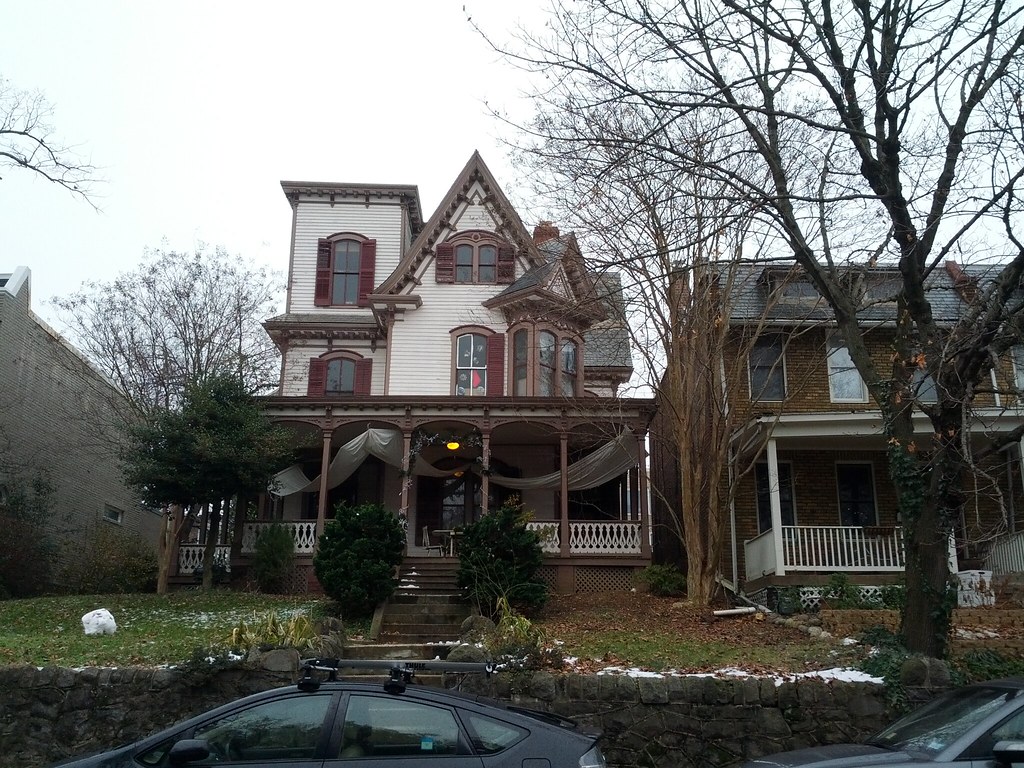
Carpenter Gothic is a 19th-century American architectural style that translated Gothic Revival forms - the pointed arch, the vertical emphasis, the decorative tracery - into timber construction. The name describes the method: carpenters, working without the stone masons who built European Gothic cathedrals, reproduced the visual language of medieval church architecture using wood. The results are distinctive precisely because of the material contrast - the spire shapes and lancet window profiles of a stone cathedral rendered in painted clapboard and board-and-batten siding.
An Unusual Style for a Catholic Parish
In Florida, Carpenter Gothic buildings are almost exclusively Episcopal. The style spread through rural America largely via pattern books published by designers and writers including Andrew Jackson Downing (primarily a landscape gardener and horticulturist rather than an architect), and in the South it became standard for modest Episcopal parish churches built through the late 19th and early 20th centuries. Finding a Carpenter Gothic Catholic church in Florida is unusual. Finding one built by Polish immigrants on the edge of a cypress swamp in 1914 is unique - and likely reflects the practical choices of builders working from available pattern-book plans rather than any formal architectural direction from the Diocese.
The building's design features repay a close look from the exterior:
- Board-and-batten exterior siding - the hallmark of Carpenter Gothic's vertical visual emphasis
- Pointed arched windows that echo Gothic stonework translated into wood framing
- A steep-pitched roof that gives the building a strong vertical silhouette against the flat surrounding landscape
- A compact footprint under two thousand square feet, with a sanctuary that seats roughly sixty, suited to an intimate pioneer parish
- Simple interior finishes consistent with a frontier Catholic parish building from local and salvaged materials
St. Mary Catholic Church is the oldest surviving church building in Flagler County. It was added to the National Register of Historic Places on January 25, 2024, recognized for its architectural rarity and its role in documenting Polish immigration to Florida.
A Polish-language Mass has been offered weekly at St. Mary since Father Baczyk celebrated the first in May 1914 - an unbroken thread of community practice running more than a century through the same building, on the same ground.
The White Eagle Era
By the mid-1920s, Korona had survived its frontier decade. The first generation of settlers had cleared land, dug drainage ditches, and built the basic infrastructure the development company never provided. The Florida land boom of the 1920s brought speculative energy up and down the east coast, and Korona - stabilized, with a functioning parish and a small commercial presence on US-1 - was positioned to participate in it.
In 1926, community member Barney Trojanowski built the White Eagle Hotel on the highway. The building did several things at once, the way commercial buildings in small communities always do: the ground floor housed a grocery, a feed store, and a real estate office; the upper floor provided rooms for tourists and travelers moving up and down what was then the primary east coast road. The name - White Eagle, the national symbol of Poland - announced to passing motorists that this stretch of US-1 had an identity and that the community behind it had not forgotten where it came from.
The land boom collapsed in 1926-27, compounded by hurricane damage and years of speculative overextension. The Depression that followed was severe in agricultural communities across Florida, where the collapse had come years before the national financial crisis of 1929. Korona felt it. Many families had already walked away from their original land purchases during the first decade, reducing the settlement's population. Those who remained were there because they had made the land work, which meant they already knew how to operate without comfortable margins.
The White Eagle Hotel did not survive the postwar period. When US Highway 1 was widened from two lanes to four in 1959, the building was demolished to accommodate the expanded roadway. It had stood thirty-three years - long enough to anchor a generation of community memory and commercial activity. After 1959, the name survived but the building that had carried it was gone.
The Shrine of Saint Christopher and the US-1 World
In 1935, in the depth of the Depression, the Korona parish erected the Shrine of Saint Christopher on US-1 as a roadside rest stop where motorists could pull over and pray to the patron saint of travelers.
Some context makes this more than a religious footnote. In 1935, US Highway 1 was not a secondary road. It was the primary north-south artery on the eastern seaboard - the route that connected Maine to Miami, that tourists drove south in winter and truckers ran freight year-round. The modern interstate highway system did not exist and would not exist for another twenty years. Everyone traveling between Jacksonville and Daytona Beach used US-1, and the entire commercial landscape along it had evolved to serve that captive traffic: tourist courts, diners, roadside fruit stands, and the increasing variety of stops and attractions competing for the attention of drivers spending hours on a single two-lane road.
A roadside shrine positioned on US-1 in 1935 would have been seen by everyone passing through the corridor. It served Catholic motorists who wanted to pray for safe travel. It also put Korona on the mental map of thousands of drivers who would otherwise have passed through without registering that a Polish community lived fifty yards off the highway. The patron saint of travelers, invoked at a rest stop on the main road to Florida, carried particular resonance for a community whose founders had arrived via a marketed journey that turned out to be something very different from what they were sold.
How Korona Held On
Several forces after World War II worked against Korona's survival as a distinct community. The post office had operated since April 27, 1918, running out of Father Baczyk's duplex adjacent to the church - a measure of how completely the priest and the parish were the community's institutional core. The Postal Service closed it in 1950. Without a post office, Korona existed on maps as an address but not as a recognized place.
The 1959 US-1 widening that took the White Eagle Hotel also changed the corridor's character. A four-lane highway moves traffic through a landscape differently than a two-lane road does - faster, with less reason to slow or stop, less visual engagement with the roadside communities along it. Communities that had built their identity partly around being visible and accessible on US-1 found that the widened highway was harder to claim as local space.
Suburban growth after 1960 built outward from Bunnell and later from Palm Coast without routing through Korona. The settlement remained six miles south of Bunnell at the US-1 and Old Dixie Highway junction, easy to pass through without registering, its scale largely unchanged from the 1914 footprint.
The Parish as the Mechanism of Survival
The institution that held Korona together through all of this was the parish. The church had been built first because the founders understood what an institution does that a farm or a store cannot: it creates an obligation to return, a schedule that structures community life, a physical building that carries collective memory. The weekly Polish-language Mass continued through the post office closure, the hotel's demolition, the highway widening, and the suburban growth that bypassed the community entirely. That continuity is not incidental to Korona's survival. It is the mechanism of it.
Visiting Korona
Korona sits at the intersection of US-1 and CR 2002 - also called Old Dixie Highway - approximately six miles south of Bunnell. A roundabout built in 2018-19 marks the junction, easy to identify from either direction on US-1 though no large signs announce the community from the highway. The site rewards a planned stop rather than a drive-by.
What to see, working from the original settlement outward:
- The original 1914 St. Mary Catholic Church - the Carpenter Gothic building in white board-and-batten, the oldest church in Flagler County. Walk around the exterior to read the pointed arched windows and steep roof pitch from different angles; the vertical silhouette is most striking from the side elevation against the flat surrounding landscape.
- The 1994 modern church building adjacent to the original, built when the growing parish needed more capacity. The two buildings standing side by side make the century of difference visible in a single frame, and that contrast is itself part of the story of how the community held together long enough to need more space.
- The Shrine of Saint Christopher near US-1 - a surviving piece of 1930s roadside Catholic culture at a scale and type that has largely disappeared from the American highway.
- The White Eagle Bar, which occupies the community's commercial node and carries forward the name Trojanowski gave his hotel in 1926 - a present-day echo of the cultural marking the community did on that stretch of highway nearly a century ago.
For the Polish-language Mass, check current service times through the Diocese of St. Augustine website rather than relying on third-party schedules - times and days can change, and the official diocesan source will carry current information. The church exterior and grounds are accessible during daylight. The interior is an active parish building, so access depends on service schedules and parish hospitality.
Adjacent Heritage Corridor stops worth combining: Bulow Plantation Ruins Historic State Park is roughly twelve miles north, connecting the Korona story to the plantation-era landscape the turpentine operators who founded the development company would have known directly. Flagler Beach sits a few miles south, where US-1 meets the coast road and the heritage of the highway corridor shifts toward the beach tourism culture that grew alongside it.
Korona and the Corridor's Long Pattern
In 1768, a Scottish physician named Andrew Turnbull recruited around 1,400 indentured workers - Minorcans, Greeks, Italians, and others from across the Mediterranean - to work his New Smyrna indigo plantation, roughly forty miles south of Korona on the same coastal corridor. He promised land grants and freedom after a period of service. What they found was forced labor, inadequate food, and conditions close to captivity. After years of brutal treatment, the survivors walked north to St. Augustine in 1777 and the settlement collapsed entirely.
One hundred and forty-six years later, thirty-five Polish families stepped off a train into a cypress swamp on the same corridor, sold on promises made by men who had no intention of delivering them.
| Detail | New Smyrna Minorcans (1768) | Korona Polish Settlers (1914) |
|---|---|---|
| Who recruited them | Andrew Turnbull, Scottish physician and landowner | Bunnell Development Company, former turpentine operators |
| Recruiting method | Contracts signed in Mediterranean ports | Polish-language newsletter, chartered excursion train |
| What was promised | Land grants and freedom after service | Fertile farmland, mild climate, three crops a year |
| What they found | Forced labor, disease, inadequate supplies | Cypress swamp, no roads, no drainage |
| Outcome for settlement | Survivors left; settlement abandoned | Community persisted; still active today |
| Lasting cultural marker | Minorcan identity in St. Augustine | St. Mary Church, weekly Polish Mass |
The difference in outcomes is partly about the terms of arrival. Turnbull controlled everything the Minorcans needed to survive; when he withheld it, they had no recourse except to leave. The Polish settlers in Korona had bought their land, which gave them legal standing and a genuine stake in staying. They also had an institution - the parish - that was independent of the developer and carried its own authority separate from anything the Bunnell Development Company could grant or withdraw.
But the deeper pattern is consistent across a century and a half: this corridor's landscape and climate were sold to distant people by men who understood the gap between description and reality and profited from that gap before the buyers arrived to discover it. The Heritage Corridor runs through territory that multiple groups of immigrants were told was something it was not. Korona is the best-preserved evidence of what happened when one of those groups decided to stay anyway - and the Polish Mass still said in the original 1914 building is the most direct expression of how that decision held.
Frequently Asked Questions
Is St. Mary Catholic Church in Korona open to visitors?
The exterior of the 1914 Carpenter Gothic building is visible and accessible from the grounds at the US-1 and Old Dixie Highway intersection. The interior is an active parish church, so access depends on service times and parish policy. The Diocese of St. Augustine website is the right starting point for current service information and any visitor guidance the parish provides.
Why is a Carpenter Gothic Catholic church unusual in Florida?
Carpenter Gothic spread through rural America primarily through Episcopal congregations, which adopted the style from pattern books tied to the Gothic Revival movement of the mid-to-late 1800s. In Florida, nearly all Carpenter Gothic buildings are Episcopal - the style became standard for modest rural Episcopal parishes, not Catholic ones. St. Mary's design most likely reflects the practical decisions of its Polish immigrant builders in 1914, working from available plans and local materials, rather than any formal direction from the Diocese of St. Augustine.
What happened to the White Eagle Hotel?
Barney Trojanowski's 1926 hotel was demolished in 1959 when US Highway 1 was widened from two lanes to four lanes, requiring the roadbed to expand into the building's footprint. The White Eagle name carries forward at the present-day White Eagle Bar on the same stretch of US-1, maintaining the cultural identity that Trojanowski established when he chose the Polish national symbol for his hotel's name nearly a century ago.
What is the Shrine of Saint Christopher and is it still there?
The parish erected the roadside shrine in 1935 on US-1, originally serving as a rest stop where motorists on the main east coast highway could pray to the patron saint of travelers. The shrine still stands near the highway intersection. It is a rare surviving example of the roadside religious landmarks that dotted major American highways in the pre-interstate era, when US-1 carried all the traffic now divided across I-95 and the Florida Turnpike.
How does Korona connect to the broader Heritage Corridor?
Korona sits roughly six miles south of Bunnell at the US-1 and Old Dixie Highway roundabout, and fits naturally into a drive along the corridor between Bunnell to the north and Flagler Beach to the south. Its founding story connects directly to the turpentine industry covered elsewhere in the corridor - the men who created the land company were former turpentine operators who pivoted to real estate when naval stores declined. The Minorcan colony story at New Smyrna Beach, roughly forty miles south, runs the same developer-recruitment pattern on the same corridor 146 years earlier.
How long has the Polish-language Mass been offered at Korona?
Father Andrew Baczyk celebrated the first Polish-language Mass at St. Mary on May 3, 1914, in the original Carpenter Gothic building that still stands. Weekly Polish-language services have continued since then - more than 110 years of unbroken practice in the same structure. For a community that began as a developer's sales proposition on a cypress swamp, that continuity is the most accurate single measure of what the place became.