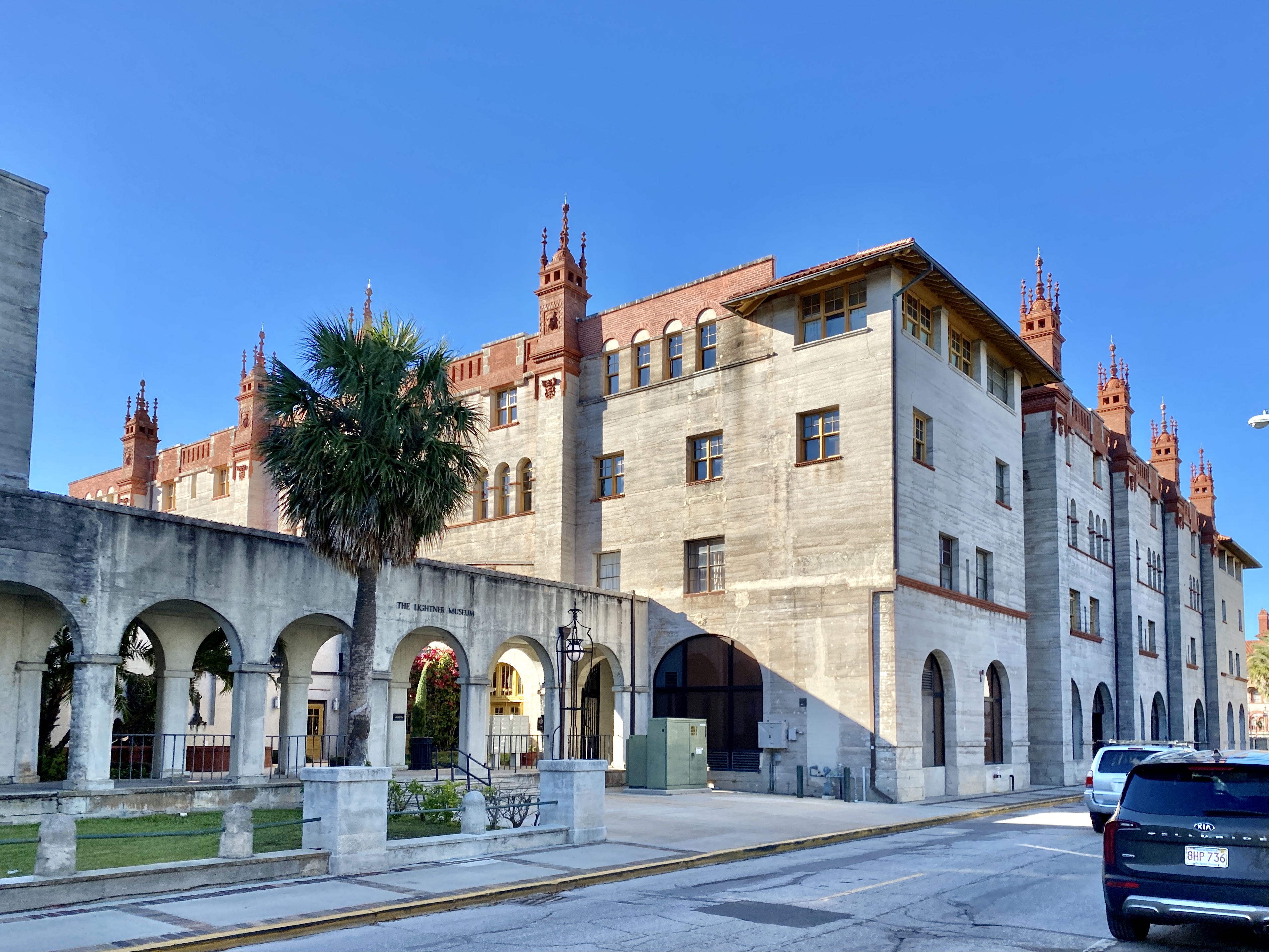
At the bottom of the old Hotel Alcazar, in the shell of what was once the largest indoor swimming pool in the world, a guitarist is playing something in the classical style and a couple at the next table is splitting a sandwich. The water has been gone since 1932. The vaulted ceiling overhead is original. So are the walls, poured from concrete mixed with coquina shell, still holding exactly as they did when guests of Henry Flagler's winter resort climbed down into this basin and swam lengths in front of an audience. If you look up from your lunch toward the ballroom balcony above, you can see people peering down at the room you are sitting in - the same view the original guests had from above, the same geometry, an entirely different activity.
The Paired Hotels: Why Flagler Built Two Grand Resorts Across the Same Street
Henry Flagler did not build the Alcazar as a competitor to the Hotel Ponce de Leon. He built it as the other half of a system.
The Ponce de Leon opened in 1888 as the flagship of Flagler's campaign to make St. Augustine the winter destination for wealthy Northern Americans. It was the more expensive property, more ornate, with higher room rates. The Alcazar opened on Christmas Day of that same year, directly across King Street. The arrangement was deliberate. Ponce de Leon guests - the ones paying the premium rates for the more decorated rooms - walked across the street to use the Alcazar's recreational facilities: the pool, the baths, the ballroom, the gymnasium, the tennis courts. The Alcazar had 300 guest rooms of its own, but its core function was the Casino wing south of the main hotel block.
This made the Flagler complex the first planned resort-spa campus in America. The two buildings did not compete. They divided labor. The Ponce de Leon provided luxury accommodation; the Alcazar provided everything a guest needed beyond a bed. King Street was just a very wide corridor between two wings of the same operation.
No other resort in the country had been built this way before. The concept - anchor hotel plus dedicated recreational facility, conceived together and operated as one campus - would not become standard in American resort design for decades.
| Feature | Hotel Ponce de Leon | Hotel Alcazar |
|---|---|---|
| Primary purpose | Luxury accommodation | Recreation and spa annex |
| Guest rate | Higher - flagship property | Lower - secondary lodging |
| Architectural emphasis | Interior opulence, decorated dining hall | Moorish facade, recreational wings |
| Depression-era fate | Survived as hotel until 1967 | Closed 1932, vacant until 1947 |
| Current use | Flagler College | Museum and City Hall |
Carrere and Hastings: How St. Augustine Launched a National Career
When Flagler hired architects for his St. Augustine hotels, he gave the commission to two men who had not yet designed a single building on their own. John Merven Carrere and Thomas Hastings had met at the Ecole des Beaux-Arts in Paris, trained in the rigorous French academic tradition, and returned to New York to work under McKim, Mead and White - at that moment the most prestigious firm in the country. When Flagler's commission arrived, Carrere and Hastings were still on that payroll. The Alcazar and the Ponce de Leon were their exit.
From St. Augustine to Fifth Avenue
The St. Augustine hotels established the firm's reputation fast. The buildings were large, technically ambitious, and finished on schedule. Within a decade, Carrere and Hastings were competing for the most significant public commission in the country. They won the design competition for the New York Public Library in 1897. The building - the one on Fifth Avenue with the stone lions at the entrance - was dedicated in 1911.
The firm's subsequent commissions read like a catalog of American civic architecture:
- The Frick Collection mansion on Fifth Avenue, New York City
- The Russell Senate Office Building in Washington, D.C.
- The Memorial Amphitheater at Arlington National Cemetery
None of that happens without the Flagler contract. Two young architects, still employed by someone else, given their first independent commission by a railroad millionaire who wanted a swimming pool in Florida - that is where the career begins.
Building in Concrete and Coquina
The Alcazar looks like stone. Its Moorish arches and terra cotta ornament draw the eye away from its structure, which is the point. But the walls are cast concrete, poured using coquina shell as aggregate - the same compressed-shell limestone that underlies much of the Florida coast and that local builders had used for centuries. What made the Alcazar different was scale. Along with the Ponce de Leon across the street, it was among the first large, multistory poured-concrete buildings in the United States. These were technically unprecedented structures dressed in historical clothing.
The terra cotta detailing applied over the concrete surface achieved the Spanish Renaissance Revival look Flagler's marketing required. The facade was modeled on a Moorish palace in southern Spain - the reference point for the "American Riviera" identity Flagler was selling. Modern industrial material beneath a centuries-old aesthetic: the building's construction method is a good index of everything it was trying to accomplish.
For anyone traveling the heritage corridor through Flagler, St. Johns, and Volusia counties, the coquina aggregate is worth pausing on. The shell material in the Alcazar's walls is the same geological substance you encounter in coquina outcroppings along the Atlantic coast further south. It is a hyperlocal material deployed at an unprecedented scale, binding the building to the land it sits on in a way the Spanish Revival styling never quite could.
The Casino Complex and the World's Largest Indoor Pool
The south wing of the Alcazar - the Casino - was what guests came for. The main hotel block provided beds; the Casino provided everything else.
The Pool
The indoor swimming pool was 120 feet long and 50 feet wide, with depths running from 3 feet at the shallow end to 12 feet at the deep. It sat beneath a semi-retractable louvered roof that could be opened on clear Florida days to admit natural light and moving air. At the time it opened in 1888, it was the largest indoor pool in the world. The scale was deliberately social as well as athletic - wide enough for spectators to watch from the edges, long enough for lap swimming, tall enough to feel like a civic building rather than a private amenity.
The Rest of the Casino Wing
The pool was the anchor, but the Casino offered considerably more than swimming:
- Turkish baths and Russian steam baths
- Sulfur baths drawing on natural mineral springs
- A fully equipped gymnasium
- A bowling alley
- A movie theater
- Tennis courts
- A three-story grand ballroom
No American resort in 1888 offered this range under a single roof. When Ponce de Leon guests crossed King Street and entered the Casino wing, they had access to a recreational package that the resort industry would not standardize for another generation.
The American Riviera: Gilded Age Life and the Social World of the 1890s Alcazar
Flagler's marketing language for St. Augustine was not subtle: this was the American Riviera. The comparison to the French and Italian coasts was deliberate. Wealthy Northerners who could not or chose not to travel to Europe for the winter could come to Florida instead, stay in buildings that looked like Moorish palaces, swim in the largest pool on the continent, and take the sulfur baths their doctors had recommended. The Alcazar's facade - modeled on a Moorish palace in southern Spain - sold the fantasy before guests set foot inside.
The fantasy worked on people with options. The guest register across the Alcazar's decades included:
- President Grover Cleveland
- Will Rogers
- George Gershwin
- Jack Benny
- Cole Porter
- Bob Hope
These were not people who lacked alternatives. They came because St. Augustine, in the winter social season of the 1890s and early 1900s, was where the season happened to be. The Alcazar and the Ponce de Leon together created a critical mass that individual resorts could not match - another downstream consequence of the paired-campus model Flagler had engineered. Each hotel made the other more valuable by existing.
Why the Depression Closed the Alcazar but Not the Ponce de Leon
Both hotels struggled as leisure travel collapsed after 1929. Only one of them closed, and the reason comes down to revenue model, not building quality or management failure.
The Ponce de Leon's survival came from its structure as a hotel. Guests paid for rooms, and even reduced occupancy generated income against fixed costs. It kept operating through the Depression years, eventually closing in 1967 - not because it went bankrupt, but because the market for Gilded Age grand hotels had exhausted itself across the whole industry. It became Flagler College and continues that way today.
The Alcazar's income depended on a different customer: the day-use visitor. People who came to use the pool, the baths, and the Casino facilities paid by the hour or the visit rather than by the room night. When the Depression cut leisure travel, that traffic collapsed faster and more completely than hotel occupancy. Someone who could not afford a winter vacation certainly could not afford an afternoon at the sulfur baths. The Alcazar closed in 1932. The pool was drained, the ballroom locked, the bowling lanes dark for fifteen years.
The building that could not survive the Depression as a spa resort has outlasted its competitor as a cultural institution - a reversal that says something about the difference between operational resilience and architectural staying power.
Otto Lightner's Unlikely Rescue
The Alcazar sat vacant from 1932 to 1947. It was a large building made of poured concrete and coquina aggregate, structurally sound, deteriorating slowly rather than catastrophically. It just sat there.
The man who rescued it was a Chicago publisher named Otto C. Lightner, and his background explains everything about what the building became. Lightner had made his money from a magazine called "Hobbies" - a publication for collectors and hobbyists that helped define and amplify the American hobbyist movement at its mid-century peak. Lightner was not a passive publisher. He collected voraciously himself, primarily Victorian material culture at a moment when the decorative arts of the previous century were deeply unfashionable and therefore cheap. He had accumulated more than 20,000 objects.
What he needed was somewhere to put them.
The logic of the Alcazar was practical as much as visionary: a large, concrete building with generous floor plates, natural light from the Casino wing's modified roof, and enough square footage to display a collection that would overwhelm a conventional museum. Lightner purchased it in 1947 and donated it to the City of St. Augustine. The city, in return, used part of the building for municipal government functions. The Lightner Museum and St. Augustine City Hall have occupied the same building ever since, one of the more unusual institutional arrangements in Florida civic life. The museum opened in 1948, the building having been vacant for sixteen years.
Inside the Collection: Machines, Glass, a Mummy, and Churchill's Lion
Lightner's 20,000-plus objects reflect the organized energy of a serious hobbyist who bought without an overriding curatorial theory. That breadth is part of what makes the collection worth a full visit rather than a quick walk-through.
The Mechanical Music Machines
The first-floor mechanical music collection is what most visitors remember longest. Lightner assembled a substantial group of Victorian mechanical musical instruments - orchestrions, player pianos, and reproducing pianos dating from roughly the 1870s through the 1920s. These were the automated entertainment systems of their era, capable of filling a room with orchestral sound without human performers present. Museum staff demonstrate the instruments for visitors on the first floor. The demonstrations matter: objects that might otherwise look like ornate furniture reveal themselves as genuinely loud, complex machines with their own personalities. If you visit without catching a demonstration, you have missed the point of this floor.
American Art Glass and Victorian Decorative Arts
The second floor holds the collection's decorative arts - American art glass including works from Louis Comfort Tiffany's studio, alongside Sevres porcelain, cut glass, and blown glass spanning the Victorian era. The glass alone would justify the floor. The collection is comprehensive enough to function as a survey of an entire period of American craftsmanship.
The Stranger Objects
Lightner was a hobbyist first and a curator second, and the collection reflects that hierarchy. It includes:
- An Egyptian mummy
- A shrunken head
- Winston Churchill's pet lion, taxidermied
- Native American artifacts
These objects are not anomalies. They are accurate reflections of Lightner's collecting identity and of the mid-century American hobbyist culture he helped build - a culture that valued curiosity, breadth, and acquisition over academic specialization. The lion is real. The mummy is real. They occupy the same building as a government planning office, two floors above a former Turkish bath. This is the full Lightner experience, and it is stranger than any promotional material suggests.
Visiting Today: The Pool Restaurant, City Hall, and What to Know Before You Go
Planning Your Visit Step by Step
- Check current admission fees and hours at lightnermuseum.org before leaving your accommodation - seasonal schedules vary, and the fee is set by the museum independently of the city.
- Time your arrival to coincide with a first-floor musical instrument demonstration; ask at the entrance desk when the next one is scheduled, then work backward from that time.
- Before going to the first floor, walk the upper balcony of the old ballroom and look down into the drained pool from above - you will understand the pool's original scale and the room's geometry before you are inside it.
- Descend into the pool and have lunch at Cafe Alcazar, which operates at midday with live classical guitar or piano; check current hours directly with the cafe before planning a meal around it.
- After leaving the museum, cross King Street and look at the Ponce de Leon from the sidewalk - seeing both buildings from street level makes the paired-campus system visible in a way that floor plans and photographs cannot capture.
Practical Notes
The museum charges an admission fee for entry to the main collection floors. The cafe in the drained pool operates on its own schedule and may have a separate entry arrangement - confirm the current policy with the museum before assuming that a museum ticket covers cafe access, or vice versa. The City Hall portion of the building is not part of the museum tour and runs on government office hours.
Parking in the historic district is limited and the streets are narrow. The building sits on King Street in the central core of St. Augustine's historic area, within walking distance of the Castillo de San Marcos and most of the city's other landmarks. Expect to park at a distance and walk rather than finding a spot adjacent to the building.
Frequently Asked Questions
Is the Lightner Museum actually inside St. Augustine City Hall?
Yes - they are the same building. When Otto Lightner donated the former Hotel Alcazar to the city in 1947, the arrangement gave St. Augustine use of part of the building for municipal offices. City Hall and the museum have coexisted there since the building reopened in 1948. You will encounter both if you explore the full structure rather than staying only on the main museum floors.
Can you eat at Cafe Alcazar in the drained pool without paying museum admission?
Cafe Alcazar operates in the former swimming pool on its own hours and policies, which can differ from museum admission requirements. Whether a meal there requires a full museum ticket depends on current arrangements that the museum adjusts periodically. Contact the museum or the cafe directly before your visit rather than assuming either way.
What happened to the Hotel Ponce de Leon across the street?
The Ponce de Leon kept operating through the Depression and beyond, finally closing in 1967 after the market for grand Gilded Age hotels had effectively ended nationally. Flagler College purchased the building and has operated there since 1968. The college offers tours of the interior - including the original decorated dining hall ceiling - and the building is visible directly across King Street from the Lightner Museum.
When are the mechanical musical instrument demonstrations held?
The first-floor demonstrations of orchestrions, player pianos, and reproducing pianos run on a schedule during museum hours, but the timing shifts with staffing and seasons. Ask at the entrance when you arrive rather than assuming a fixed daily time. The demonstrations transform the instruments from display objects into functioning machines and are worth planning the first part of your visit around.
Is the swimming pool structure still physically there, or was it removed?
The concrete basin, the walls, and the vaulted space above the pool are all original and intact. What is gone is the water, drained when the hotel closed in 1932. The pool now serves as the floor of Cafe Alcazar. You can look down into it from the ballroom balcony above before descending to the restaurant level - an easy way to grasp the original depth and scale of the room.
How does the New York Public Library connect to the Alcazar's architects?
Carrere and Hastings, who designed both the Alcazar and the Hotel Ponce de Leon as their first independent commission, went on to win the design competition for the New York Public Library's main Fifth Avenue branch in 1897. The library was dedicated in 1911 - the same year co-founder John Carrere died in an automobile accident, before he could attend the opening. The St. Augustine hotels were the proof of work that made their national career possible.