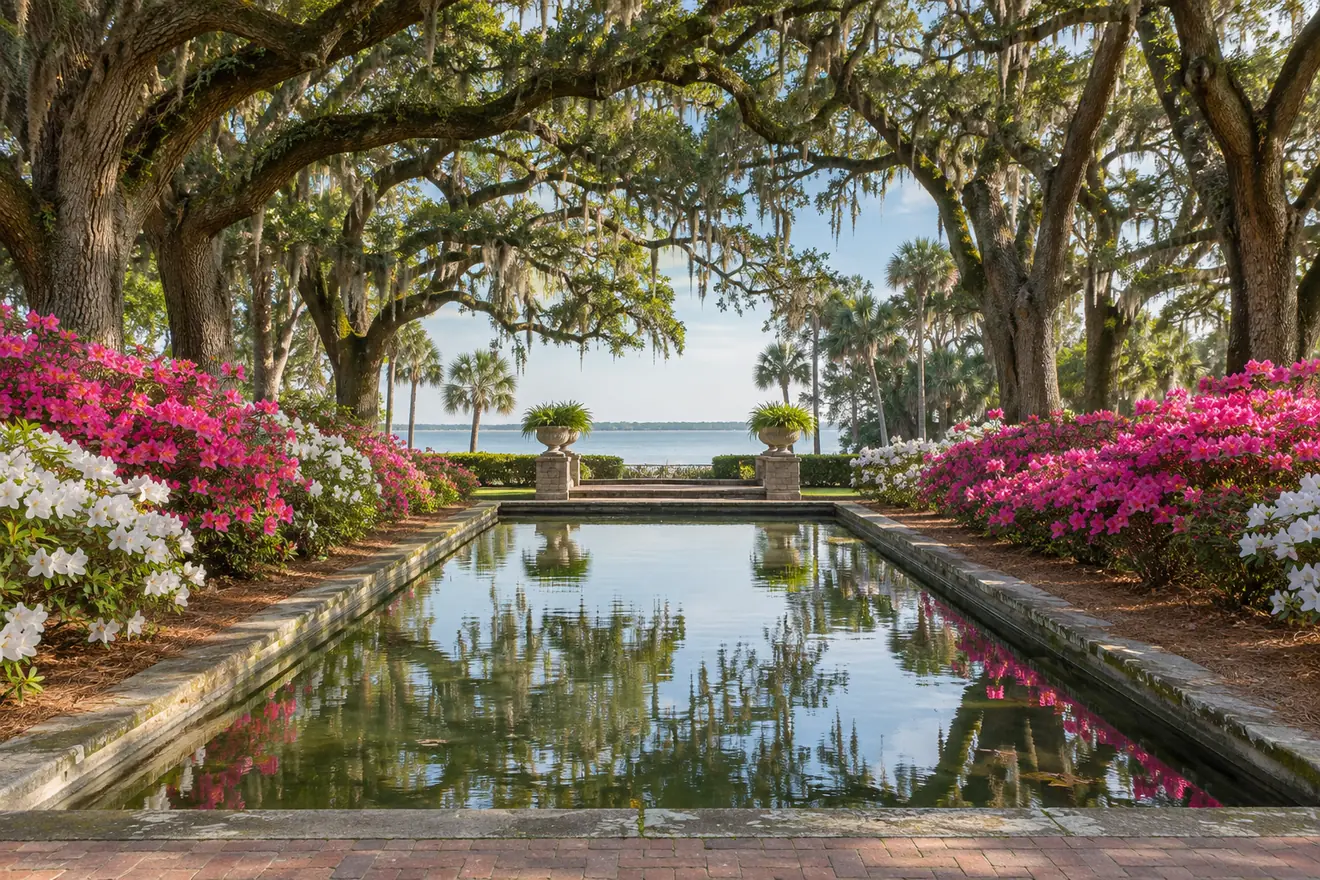
The main attractions in Flagler County, Florida, are Washington Oaks Gardens State Park, the coquina ruins of Bulow Plantation, the Florida Agricultural Museum, the beach and fishing pier at Flagler Beach, and a string of creek, swamp and Intracoastal preserves. The county was created in 1917 and has about 18 miles of Atlantic coastline, so most things to do here are outdoors, historical, or both. This page sorts them by what you want to see.
Flagler County attractions at a glance
- Formal gardens and coquina shoreline: Washington Oaks Gardens State Park.
- Plantation and sugar mill ruins: Bulow Plantation Ruins Historic State Park.
- Living-history farm museum: Florida Agricultural Museum in Palm Coast.
- Beach, camping and sea turtles: Gamble Rogers Memorial State Recreation Area.
- Pier and small beach town: Flagler Beach Municipal Pier.
- Oceanarium history: Marineland of Florida, opened in 1938.
Coastal gardens and shoreline park
Washington Oaks Gardens State Park sits on a barrier island and covers about 425 acres. It preserves formal gardens planted under a canopy of live oaks, with reflecting pools, azaleas and camellias in the cool season and ocean access across the highway. The coquina rock formations exposed on this beach are unusual on Florida's Atlantic coast, and the Matanzas River side of the park has its own shoreline. The grounds began as a winter home: Louise Powis Clark, wife of industrialist Owen D. Young, bought the property in 1936, and the family donated it to the state in 1964 on the condition that the gardens be maintained in their present form. Its historic district has been on the National Register of Historic Places since 2009 (source: Wikipedia, Washington Oaks Gardens State Park).
Sugar mill ruins
Coquina walls, a chimney and the foundations of the boiling house stand in a forest of oak and palm near the creek that served the plantation. The site is a state historic park with a short interpretive trail and a picnic area. Bring insect repellent in warm months.
Charles Wilhelm Bulow began developing the plantation in 1821, and the naturalist John James Audubon stayed there in the winter of 1831-1832. The plantation was destroyed in the Second Seminole War in 1836 (see how the war ended East Florida's plantation era). Florida acquired the land in 1945 and the ruins were listed on the National Register of Historic Places in 1970 (source: Wikipedia, Bulow Plantation Ruins Historic State Park). This park keeps shorter hours than most state parks, so confirm days and times with Florida State Parks before you drive out.
Agricultural museum
The Florida Agricultural Museum is a large open-air site preserving Florida farm life: period buildings, working livestock, orange grove equipment and cracker cattle history. Its grounds, at 7900 Old Kings Road in Palm Coast, include a restored 1890s pioneer homestead, an early 20th-century dry goods store and five restored buildings from a 1930s citrus operation. It works well for families and for anyone who wants to understand what the flat land west of the coast has actually produced for a century. Programs and open days change, so check before you go. The road it sits on is covered in the guide to Old Kings Road.
County historical museum
A small local museum in the county seat holds photographs, farm implements, railroad material and household objects from the settlement era. Volunteer staffed, limited hours, high signal per square foot. In Bunnell, the Flagler County Historical Society owns the Holden House Museum, a 1918 Craftsman bungalow, and the Little Red School House Museum was built in 1938 by Bunnell High School Future Farmers of America students. The town also has the Neoclassical Old Flagler County Courthouse, dedicated in 1927 (source: Wikipedia, Bunnell, Florida). The railroad that explains why the county exists is covered in the story of the FEC Railway and the lost towns.
Historic attractions in Flagler County
If history is your reason for coming, build the day around three layers. The Native American and Spanish-era layer shows up in Timucua sites and traces of the Old Kings Road. The plantation layer is the Bulow ruins and the other sugar-era sites. The 20th-century layer is Henry Flagler's railroad, the roadside tourism of Marineland, and the planned city of Palm Coast. The overview is on the Flagler County history page.
Marineland opened in June 1938 as Marine Studios, billed as the world's first oceanarium, and reopened in 2006 as Marineland Dolphin Adventure, a non-profit (source: Wikipedia, Marineland of Florida). Ownership and programs have changed several times, so verify what is currently open.
Preserves and creeks
- Bulow Creek corridor: ancient live oaks, hiking trails and a paddling route through tidal blackwater. Bulow Creek State Park lies just over the county line in Volusia County and adjoins the plantation ruins; its Fairchild Oak is described as more than four centuries old.
- Coastal recreation area south of the pier town: dune walkovers, camping, surf fishing. Gamble Rogers has 34 oceanfront campsites on 144 acres, and loggerhead, green and leatherback turtles nest on the beach from May to early September (source: Wikipedia). See sea turtle nesting season on the corridor.
- Inland swamp preserves: boardwalks over cypress and hardwood swamp, good birding, almost no crowds. Start with Graham Swamp Conservation Area.
- Intracoastal parks: boat ramps, fishing piers and shaded picnic ground on the waterway.
The county lists more than 40 parks and preserves and over 90 miles of trails (source: Wikipedia, Flagler County, Florida). For lowland and wading birds see the birding guide to the corridor.
The pier and beach town
The center of the coastal leg is a low-rise beach town with a fishing pier, a short commercial strip, surf shops and casual restaurants facing the water. No high-rise development, which is precisely the point. Flagler Beach has about six miles of sand with an orange tint from crushed coquina shells, and a small historical museum with a Florida-history focus (source: Wikipedia, Flagler Beach, Florida).
What to do in Flagler County by interest
- Half a day, outdoors and photogenic: Washington Oaks, then the beach at Flagler Beach.
- History: Bulow ruins, Florida Agricultural Museum, Bunnell's museums.
- Families: the agricultural museum, Marineland (if open), and the beach.
- Quiet nature: the swamp boardwalks and Bulow Creek, away from the beach crowds.
- Linking it together: the full-day scenic loop strings the main stops in order, and the suggested itineraries give shorter versions. For towns and bases, see the towns of Flagler County; for timing, the best time to visit.
Practical notes
State parks charge a per-vehicle entrance fee and open at eight in the morning until sundown. County preserves are generally free. Small museums keep short and sometimes seasonal hours, so check before making one the anchor of your day. Nothing on this list requires a reservation, except camping and any guided or animal-interaction programs. Fees and hours change, so confirm on the Florida State Parks or park-operator page before you go.
Frequently Asked Questions
What are the main towns in Flagler County?
Bunnell is the county seat and Palm Coast is the largest city. Flagler Beach is the beach town, and Beverly Beach and Marineland are small towns on the coast (source: Wikipedia, Flagler County, Florida).
Are there free things to do in Flagler County?
Yes. County preserves are generally free, and so is walking the public beach and town of Flagler Beach. State parks charge a vehicle fee, and some museums and attractions charge admission.
Where can you see sea turtles in Flagler County?
Turtles nest on the county's beaches from about May to early September, including at Gamble Rogers Memorial State Recreation Area.
Which Flagler County attractions are historic?
The Bulow Plantation ruins (destroyed in 1836), the Washington Oaks historic district, Bunnell's Holden House and Old Courthouse, and Marineland, which opened in 1938, are the main historic stops.
Is Flagler County a good day trip from St. Augustine or Daytona Beach?
Yes. Gamble Rogers sits about 30 miles south of St. Augustine and 18 miles north of Daytona Beach (source: Wikipedia), so the coast along A1A fits comfortably into a day.