The sign at the entrance to Gamble Rogers Memorial State Recreation Area at Flagler Beach offers no explanation. It carries a name, and most visitors driving A1A assume it belongs to some local benefactor or county official. The campground fills on weekends with families, cyclists, and snowbirds who pitch tents within earshot of the Atlantic, unaware that the man whose name is on that sign died in that same ocean, thirty yards from shore, trying to pull a stranger out of an undertow. James Gamble Rogers IV was a folk musician, a national television performer, a weekly voice on public radio, and the creator of an entire fictional Florida county that existed only in his imagination and the minds of his audiences. He was also, on the last morning of his life, a man who entered dangerous surf with a compromised spine because a child ran to him for help. The park sign cannot tell any of that. This article can.
Born into Architecture, Drawn to Music
Rogers arrived in the world on January 31, 1937, in Winter Park, Florida, into a family whose name was carved, quite literally, into stone across two continents. His grandfather, James Gamble Rogers II, designed dozens of Central Florida landmarks. His great-great-uncle, James Gamble Rogers I, shaped Yale University's skyline - Sterling Memorial Library, Harkness Tower, and more than 20 other buildings that define what most people picture when they picture Yale. Architecture was the family business, the family reputation, the expected path.
Rogers did not become an architect. Around ages ten or eleven, he picked up a ukulele, and something locked into place. The deeper turn came when he encountered the fingerpicking style of country guitarist Merle Travis - that right-hand technique where the thumb holds a steady bass pattern while the fingers pull melody off the treble strings, creating what sounds like two players but is one. Rogers switched to guitar and spent years building that technique into muscle memory. He was also developing spinal arthritis in his teenage years, a condition that would worsen across the rest of his life in ways he could not have anticipated when he was a young man learning guitar runs in Central Florida.
The Serendipity Singers and National Television
The career break came sideways, as these things often do. Rogers was in New York City visiting a friend when he learned that a new folk group called the Serendipity Singers was holding auditions. He walked in on a whim. He walked out as their guitarist and lead storyteller. Within two years, he was on three of the most-watched programs on American television.
- The Ed Sullivan Show - the Sunday-night institution that had already put Elvis and the Beatles in front of mass American audiences, and that carried the same weight for folk acts in the early 1960s
- The Tonight Show - network late-night at the height of its cultural reach, a booking that meant the whole country knew your name by morning
- Hootenanny - ABC's dedicated folk-music showcase, which ran during the folk boom and brought the genre into suburban living rooms that would never have sought it out otherwise
Two years was enough. Rogers had shown he could hold a national stage. He had also confirmed that a group format was not where his particular gifts lived. He came back to Florida and started over as a solo performer, with no safety net and no label behind him - just the guitar, the voice, and the stories that were already forming.
Return to Florida: Three Decades on the Folk Circuit
His first appearance at the Florida Folk Festival - the state's oldest folk music gathering, held annually at White Springs in the Suwannee River country - came in 1959, the year before he joined the Serendipity Singers. He would return nearly every year for three decades. By tradition, Rogers closed the Sunday-night program, the last act of the weekend, the slot that organizers protect for the performer the audience will stay late to hear. Holding that position year after year is not a booking. It is a kind of tenure.
Building a regional following is slow work: highway miles, small venues, outdoor stages in August heat. Rogers did it steadily, and what he was building was something specific. He was not trying to re-enter the national market he had briefly touched with the Serendipity Singers. He was making art that was rooted in Florida - its landscape, its people, its particular mixture of the absurd and the lovely. The audiences at those Sunday-night closings understood exactly what he was doing, and they came back every year to find out what he had added to it.
Oklawaha County: A State of Mind
The creative engine of Rogers's solo career was a fictional Florida county he called Oklawaha. He described it in terms that were clear and absolute: not a place, but a state of mind. Oklawaha County had no location on any map, but it had a fully inhabited interior life, and Rogers returned to it across decades, building a cast of recurring characters his regular listeners knew the way you know neighbors.
- Agamemnon Abramowitz Jones - a name that contains an entire history of Florida's improbable human mixture, before anyone had a phrase for that mixture
- Downwind Dave - whose name alone summons a specific Florida type: the man you find at a boat ramp at six in the morning, already knowing things about the weather that the forecast does not
- Sheriff Hutto - the law in Oklawaha County, which is to say: local, particular, and not easily summarized
Oklawaha County is not a place but a state of mind.
James Gamble Rogers IV
What Rogers grasped was that fiction tells the truth about a place more efficiently than description. Critics and fellow performers reached for comparisons to frame what he was doing: Pete Seeger for the folk authenticity and command of an audience, Mark Twain for the vernacular storytelling, Will Rogers for the gentle political wit woven through the comedy. All three comparisons hold up, and none of them lands exactly, because Oklawaha County was specifically and unmistakably Floridian in a way that none of those predecessors could have made.
A National Platform: NPR, Carnegie Hall, and the Folk Royalty Connection
Between 1982 and 1984, Rogers served as a weekly guest commentator on NPR's All Things Considered - the afternoon news program with the largest public radio audience in the country. For two years, his Florida voice reached listeners in cities that had never heard of White Springs or the Sunday-night slot. He held that audience the same way he held a concert hall: with a story that went somewhere unexpected, told by someone who clearly believed it was worth telling.
In 1985, he performed at Carnegie Hall alongside Doc Watson, the North Carolina flat-picking guitarist whose technical mastery had redefined what people understood acoustic guitar to be capable of. Rogers had built his playing on the Merle Travis fingerpicking tradition; Watson had built his on flat-picking discipline applied at a speed and precision most guitarists cannot approach. The Carnegie Hall stage held both of them, and the folk world paid attention.
The musicians who named Rogers as an influence form a short list that carries real weight.
- David Bromberg, the eclectic guitarist and multi-instrumentalist, cited Rogers directly as a formative influence on his playing and approach
- Jimmy Buffett, whose career was rooted in the Florida coastal tradition Rogers had spent decades defining, dedicated his 1994 album Fruitcakes to Rogers - a public acknowledgment made three years after Rogers died, when the dedication cost Buffett nothing commercially and meant everything personally
October 10, 1991: The Last Camp at Flagler Beach
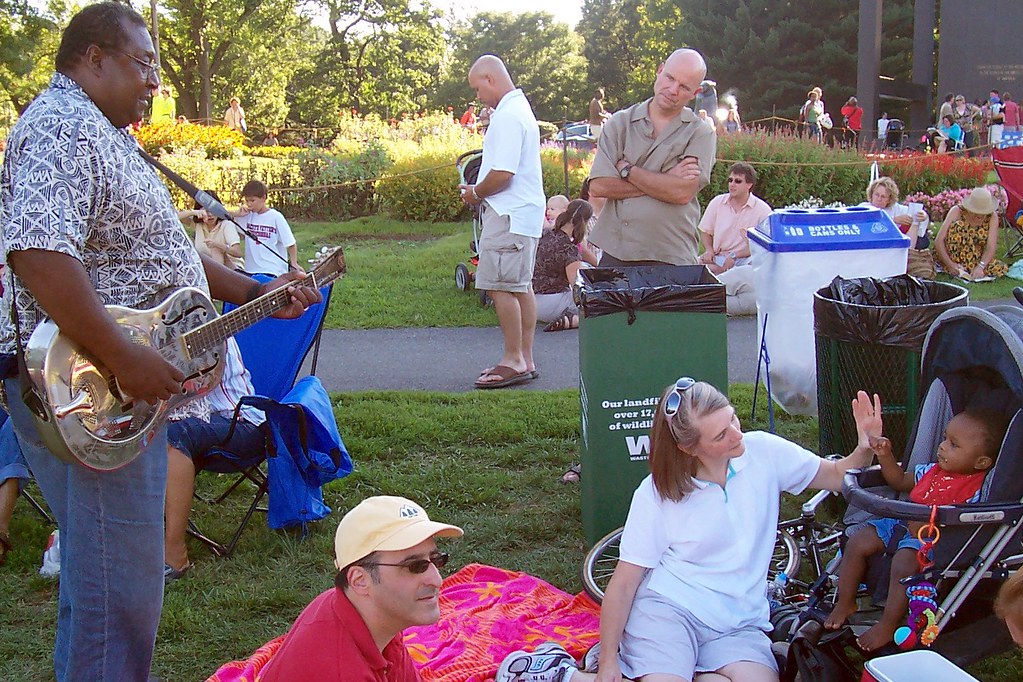
Rogers was fifty-three years old, camping at Flagler Beach with his wife Nancy, on the morning of October 10, 1991. The Atlantic surf was rough - the kind of surf that looks manageable from the sand and turns dangerous the moment you are in it. A young Canadian girl ran to Rogers in distress. Her father, Raymond Tracey, forty-eight years old, of Ontario, Canada, was in the water and in trouble.
Rogers grabbed an air mattress and went in. His spinal arthritis had been worsening since his teenage years, and by 1991 it had compromised his physical movement in ways that were apparent to anyone who knew him. Staying afloat in rough surf requires continuous, forceful movement of the legs and torso. A deteriorating spine is a serious liability in those conditions. The plastic mattress was destroyed quickly by the surf. Rogers could not stay afloat.
Both Rogers and Raymond Tracey drowned in the undertow. The girl who had run for help survived. Nancy Rogers was on the beach. She had watched her husband go in.
These details tend to disappear from the brief accounts. Most summaries of Rogers's death reduce it to a sentence, and they omit Tracey's name, his age, his province, the daughter who sought help. Two men died that morning. One of them went in by choice, knowing his body was not equal to what he was asking it to do.
The Honors That Followed
The Carnegie Hero Fund Commission awarded Rogers the Carnegie Medal posthumously in 1992. The Carnegie Medal is the highest civilian heroism recognition in the United States, given to individuals who risk their lives to an extraordinary degree to save or attempt to save others. The Commission's finding in Rogers's case was straightforward: he knew the water was dangerous, he knew his body was compromised by a condition he had carried for decades, and he went in because a child asked him to. The medal was presented to his widow, Nancy Lee Rogers, along with a monetary grant - check the Carnegie Hero Fund Commission website for details on how the program recognizes honorees.
Also in 1992, the Florida Legislature voted to rename Flagler Beach State Recreation Area as Gamble Rogers Memorial State Recreation Area at Flagler Beach, placing his name on the site where he died. For a state that tends to name public spaces after donors and elected officials, the renaming was an unusual act of cultural recognition - the Legislature acknowledging that a folk musician who died pulling strangers from the surf had a better claim on that particular piece of land than anyone else.
In 1998, seven years after his death, Rogers was inducted into the Florida Artists Hall of Fame, joining the roster of painters, writers, and musicians who built their work out of the state's specific material - its heat, its light, its layered and improbable human history. He had spent thirty years doing exactly that.
Experiencing His Legacy on the Heritage Corridor Today
The 98-mile heritage highway through Flagler, St. Johns, and Volusia counties passes through or near every significant point in Rogers's story. A traveler who wants to engage that story has three distinct entry points.
| Experience | Location | When available | What it offers |
|---|---|---|---|
| Gamble Rogers Memorial State Recreation Area | Flagler Beach, directly on A1A | Year-round | Overnight camping, beach access, the site itself |
| Gamble Rogers Folk Festival | St. Augustine, St. Johns County Fairgrounds | Annual - spring | Live folk music, workshops, Friday Night Fish Fry, on-site camping |
| Recordings and NPR archive | Streaming platforms and online archives | Any time | His guitar playing, Oklawaha County stories, the All Things Considered commentaries |
The state park is the most direct connection - camping where Rogers camped, walking the same stretch of beach. The park guide elsewhere on this site covers current amenities and reservation logistics; for fees and campsite availability, check the Florida State Parks website before you go.
The Gamble Rogers Folk Festival, established in 1995 in St. Augustine and run by the Gamble Rogers Memorial Foundation, is now in its fourth decade. The 2026 edition is the 31st annual. The three-day event at the St. Johns County Fairgrounds brings more than two dozen folk acts together each spring, with instrument and songwriting workshops, on-site camping, and a Friday Night Fish Fry to open the weekend. In structure and spirit, it is the kind of event Rogers spent his career performing at - the Florida Folk Festival model applied to his own memory. Attending it is not a detached memorial experience. It is a living continuation of the circuit he helped sustain for thirty years.
A corridor itinerary that combines both sites has a natural shape: north to south on A1A, St. Augustine to Flagler Beach - the same road Rogers drove many times on his way between performances. To get the most from it, do this in order.
- Spend an hour with recordings before you travel. Search Rogers's full name on major streaming platforms and check the NPR archive for his All Things Considered commentaries. Hearing an Oklawaha County story before you arrive changes what both sites mean when you get there.
- If the festival falls within your trip window, plan to arrive by Friday evening for the Fish Fry that opens the weekend. The main-stage crowd is smaller on the first night than it will be Saturday, and the informal atmosphere is the right moment to get oriented before the full schedule builds in around you.
- Before driving to the park, check the Florida State Parks website for any conditions alerts specific to the Gamble Rogers site. The campground sits on a narrow barrier island, and beach access can be affected by storm activity with little warning - worth confirming before you make the drive south.
- At the park, walk the beach south of the campground in the morning, when the surf is audible and the conditions read clearly. That is the time of day - and the same stretch of coast - where Rogers's story ended and where it is most directly felt.
Frequently Asked Questions
Is the campground actually located at the spot where Rogers died?
Yes. Rogers and his wife Nancy were camping at what was then Flagler Beach State Recreation Area when the rescue attempt occurred on October 10, 1991. He entered the ocean from the beach adjacent to the campground. The Florida Legislature renamed the area in his honor in 1992, making the campground itself the memorial to the event that prompted the name.
When is the Gamble Rogers Folk Festival, and do I need to buy tickets in advance?
The festival takes place annually in the spring at the St. Johns County Fairgrounds in St. Augustine. The 2026 edition is the 31st annual. Check the Gamble Rogers Memorial Foundation website for current dates, ticket prices, and lineup - those details shift year to year, and the Foundation is the authoritative source for what applies to a given edition.
Who was Raymond Tracey, and what happened to the girl who asked Rogers for help?
Raymond Tracey was a forty-eight-year-old man from Ontario, Canada, who got into serious difficulty in the rough Flagler Beach surf on October 10, 1991. He and Rogers both drowned in the undertow. The young Canadian girl who ran to Rogers for help survived; her name does not appear in available sources. Tracey's name and background are typically absent from summary accounts of Rogers's death - a gap this article attempts to correct.
What is the Carnegie Medal, and what did Rogers have to do to earn it?
The Carnegie Medal is awarded to civilians who voluntarily risk their lives to save or attempt to save another person, with no professional obligation to act. The Commission evaluates each case against a standard of extraordinary - not ordinary - risk: the hazard the person accepts must be demonstrably severe, and the person must have had a genuine choice to stand back. In Rogers's case, those elements aligned clearly. He was a camper, not a lifeguard. The surf conditions were visibly dangerous. His degenerative spinal condition was a factor he would have known about before he entered the water. Voluntary action, a known physical disadvantage, and demonstrated hazard together met the Commission's threshold. The Carnegie Hero Fund Commission covers the United States and Canada, and its website sets out the full criteria and how cases are evaluated.
Can I hear Rogers's voice and guitar playing without attending a live event?
Yes. Rogers recorded during his career, and material is available through streaming platforms - search his full name, James Gamble Rogers IV, for the best results. The NPR archive is another route in, particularly for the storytelling style that defined his 1982-1984 run on All Things Considered. The Gamble Rogers Memorial Foundation website is worth checking for any recordings or resources the Foundation maintains directly.