Stand at the base of the spiraling black-and-white tower on Anastasia Island and you are looking at a navigational landmark with roots that predate the United States by nearly two centuries. A light has guided ships into this inlet since before 1586, when Spanish colonists planted a wooden watchtower here. That is the fact that separates St. Augustine from every other lighthouse in Florida - not the tallest (that distinction belongs to the Ponce de Leon Inlet Lighthouse, 175 feet, at the Heritage Crossroads Corridor's southern bookend), but the oldest site by centuries. The 1874 brick tower still flashes its signal over the Atlantic tonight, the same Parisian Fresnel lens spinning in the same lantern room that Keeper William Russell first lit in October of that year. A visit here is layered: Spanish colonial watchtower, America's first federally recognized Florida lighthouse, a Victorian construction project marked by drowning and grief, a WWII Coast Guard garrison operating under Atlantic blackout orders, and an active underwater excavation of a Revolutionary War shipwreck just offshore. The Heritage Crossroads Highway begins, in a real sense, right here.
The Spanish Watchtowers: Before America Had Lighthouses
Spanish colonists who founded St. Augustine in 1565 understood immediately what the inlet required. The bar at the harbor entrance was shallow, the channel shifted with storms, and an unmarked crossing meant lost cargo or lost ships. Before 1586 - the year an English expedition under Francis Drake documented the settlement - they had already erected a wooden watchtower on Anastasia Island, the barrier island across the water from the town. It is the earliest recorded navigational aid in what is now the continental United States.
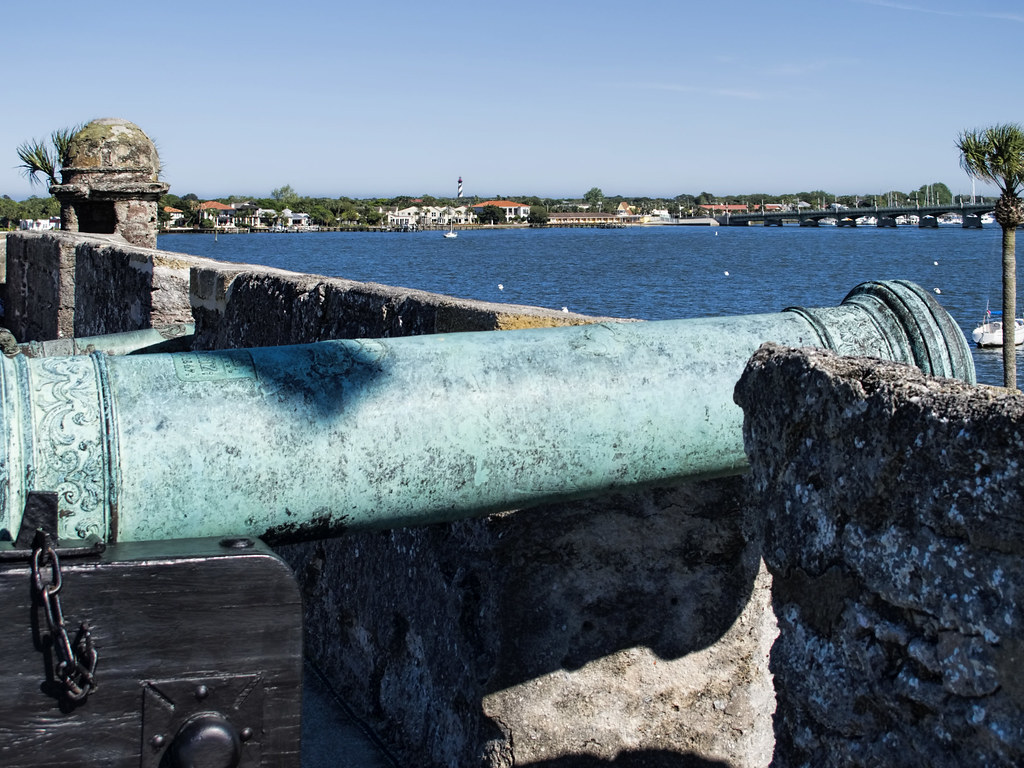
The wooden structure did not last. By 1737, Spain had rebuilt it in coquina - the shellstone quarried from Anastasia Island itself. This is the detail that every visitor guide skips: the coquina quarry that produced the 1737 lighthouse tower is the same quarry, on the same island, that had supplied the walls of Castillo de San Marcos roughly four decades before (the Castillo was completed in 1695, the lighthouse tower rebuilt in 1737 - different centuries, same geological source). The star fort standing across the inlet in St. Augustine today and the watchtower that guided ships toward it were built from the same geological deposit. The quarry pits are still visible on Anastasia Island; Anastasia State Park preserves them and a walking trail reaches the site. Standing at the pits and then standing at the lighthouse closes a loop 285 years long.
The coquina tower served through the rest of Spanish Florida's colonial period and was still standing when the United States acquired the territory from Spain in 1821.
Florida's First Official Lighthouse: 1824
The new American government did not immediately replace the Spanish structure. Congress appropriated funds in March 1823 to convert the old coquina tower into a US lighthouse - a practical decision, since the structure was standing and the location was proven. Within the year, the Treasury Department had authorized the work.
John Andreu became the first keeper. He lit the whale-oil lamps in 1824, making St. Augustine officially the first lighthouse in Florida under the American flag. That the United States chose to build on a Spanish foundation rather than start fresh is itself a piece of the story: the site's value as a navigational position had already been established over two and a half centuries.
Andreu's era meant whale-oil lamps and daily physical maintenance. Keepers trimmed wicks, replenished oil, and polished glass multiple times per night. The work was isolated, repetitive, and not well paid. What it was not was optional - a keeper who let the light fail was responsible for any ship that wrecked in consequence.
What the coquina tower lacked was permanence. Anastasia Island's Atlantic shore was eroding, measurably, year by year. The same water the lighthouse was built to help ships navigate was slowly undermining the ground beneath it.
Building the Current Tower: Tragedy and Triumph, 1871-1874
By the late 1860s, lighthouse inspectors had documented how much shoreline the island had lost. The coquina tower's days were numbered. Congress authorized a replacement, and the Lighthouse Board hired Hezekiah H. Pittee of Cape Elizabeth, Maine, as the construction supervisor. Pittee did not commute to the job. He moved his entire family to Anastasia Island for the duration.
The July 1873 Drowning
Construction on a remote barrier island in Reconstruction-era Florida was slow and dangerous. On July 10, 1873, with the tower still unfinished, a work cart loaded with sand derailed from its track and fell into the water. Pittee's two eldest daughters - Eliza and Mary - drowned, along with a young companion whose name was not recorded in historical documents. The Pittee daughters are buried in the lighthouse cemetery on the grounds, a marked historic site that visitors can walk through.
Keeper William R. Russell lit the new tower for the first time on October 15, 1874. Russell had already served in the old coquina lighthouse - he is the only keeper on record to have worked in both structures. The old tower, left standing when the new one opened, began to fall. Shoreline erosion had not stopped simply because a replacement had been built. By 1880, the coquina tower had collapsed into the sea, vindicating every argument for building the new lighthouse farther inland. Nothing remains of it above water; the submerged ruins lie offshore, the coquina slowly dissolving.
The Tower and the Lens: Engineering Worth the Climb
The 1874 tower is 165 feet tall. Reaching the lantern room requires climbing 219 spiral cast-iron steps. Most visitors take 10 to 15 minutes, depending on pace and rest stops. The stairwell is narrow and enclosed throughout.
The First-Order Fresnel Lens
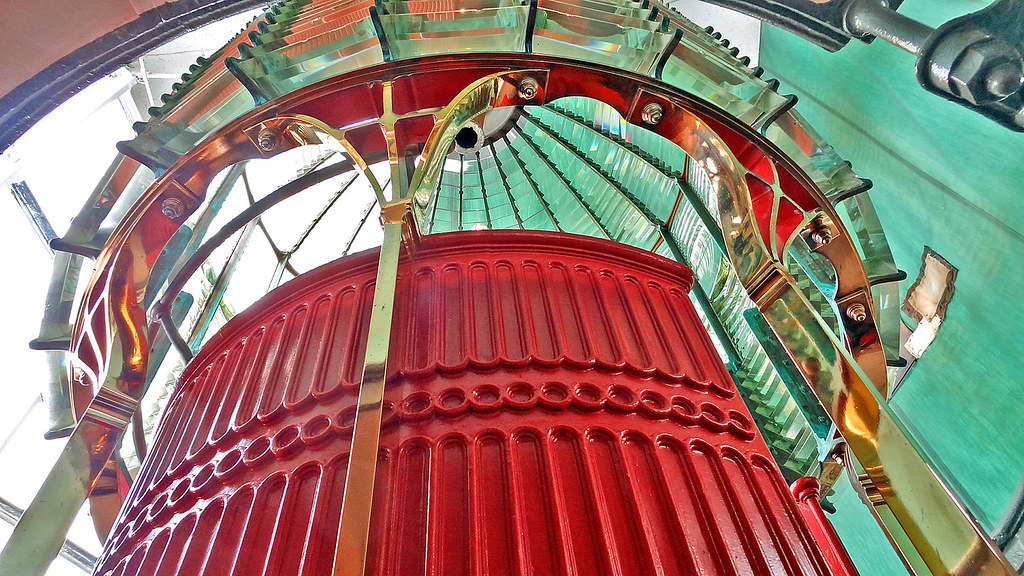
The reward at the top is one of the finest examples of 19th-century optical engineering still in active use anywhere in the United States. The first-order Fresnel lens:
- Stands 12 feet tall and 6 feet in diameter
- Contains 370 hand-cut glass prisms arranged in a beehive configuration
- Was manufactured by Sautter, Lemonnier & Cie of Paris
- Has been in active service since 1874 - more than 150 years
- Projects a beam visible more than 19 miles offshore on a clear night
First-order is the largest classification in the Fresnel system. Lenses of this size were reserved for the most critical coastal light stations - the ones ships relied on for open-ocean position fixing, not harbor approach. That this lens is still rotating, still operational, is genuinely unusual; most first-order lenses in American lighthouses have been decommissioned and placed in museums. St. Augustine's is not a museum piece. It is working equipment.
The tower's black-and-white spiral stripe - the daymark - was assigned specifically so mariners could distinguish it from every other lighthouse on the Florida coast at a glance. Spiral daymarks are used at other major lighthouses as well - Cape Hatteras in North Carolina being a well-known example - though each tower's specific configuration of bands and colors differs from tower to tower. During daylight hours, a lighthouse's color and marking pattern functions as its identity code for coastal navigation. A sailor who knows the system can read the coastline the way a driver reads road signs.
Wars, Coast Guard, and the Road to Restoration
The Civil War interrupted the lighthouse's operation early. Confederate forces removed the Fresnel lens to prevent it from aiding Union naval operations along the coast - a standard practice at Southern light stations in 1861. The lens was recovered after the war and reinstalled.
WWII: Armed Garrison, Reduced Light
The Second World War brought a more prolonged occupation. The US Coast Guard assumed responsibility for all American lighthouses in 1939, and after December 1941, the Atlantic seaboard faced a specific strategic problem: German U-boats operating close inshore were using the ambient glow of coastal cities and light stations to silhouette Allied merchant ships against the night sky. Ships were being sunk within sight of shore.
The Atlantic coast went dark. At St. Augustine, armed Coast Guardsmen moved onto the lighthouse grounds. They lived in barracks built on the property, patrolled the beach below, and stood watch from the lantern room at the top of the tower. The light kept operating - maritime navigation did not stop during wartime - but at reduced candlepower, in compliance with blackout protocols that governed the entire eastern seaboard. The Coast Guard maintained this garrison until after the war's end.
The light had been electrified in 1936, ending the era of oil lamps and round-the-clock manual tending that had defined a keeper's life since Andreu's day. After the Coast Guard relinquished management, the property passed through several hands and fell into disrepair. In 1982, the Junior Service League of St. Augustine signed a 99-year lease with the county and launched a full restoration. The museum in the restored keeper's dwelling opened to the public in 1988 - 114 years after Russell first lit the tower.
The Storm Wreck and LAMP: Archaeology on the Doorstep
Most visitors to the lighthouse do not know that an active underwater excavation is running a short distance offshore. The Lighthouse Archaeological Maritime Program - LAMP - operates out of the lighthouse site and runs one of fewer than a handful of university-level underwater archaeology field schools in the entire United States.
The 1782 Loyalist Disaster
The primary dig site is a vessel called the Storm Wreck, and its origin is specific. On December 31, 1782, sixteen ships carrying British Loyalist refugees attempted to cross the St. Augustine Bar in deteriorating weather. They were fleeing Charleston, South Carolina, after the American Revolution - part of the mass Loyalist evacuation following British defeat. The crossing failed. All sixteen vessels wrecked on the bar. The Storm Wreck is one of those ships.
The Storm Wreck is not legend or local tradition - it is one of the best-documented maritime disasters of the Revolutionary War period, and the objects it yields come from the last hours of a specific, nameable group of people who lost everything crossing that bar.
LAMP archaeologists and university students have been excavating the site since 2010. The program has recovered:
- Firearms and military hardware
- Artillery pieces and associated shot
- Cookware and galley equipment
- Personal goods that survived more than two centuries on the seafloor
- More than 600 individual catalogued artifacts
Visitors cannot dive the site. What they can do is see recovered artifacts in the museum, attend periodic public programs that LAMP offers on current fieldwork, and follow the excavation as it continues. Most lighthouse sites have no active research of any kind on their doorstep. This one has one of the most significant maritime archaeology projects in the Southeast.
Visitor Planning: Tickets, Tours, Hours, and Practical Tips
The lighthouse is open daily. Admission to the museum and tower climb is ticketed; ghost tours are priced separately and require advance booking. Check the lighthouse's official website for current admission rates and hours before visiting - both the fee structure and seasonal hours change, and citing a stale price does a visitor no favors. The ghost tours, particularly the after-hours 'Dark of the Moon' series, sell out regularly. The lighthouse has been featured in USA Today's 10Best readers' choice rankings as a top haunted destination - check the current standings at usatoday.com/10best for its latest position. Book online if you want a ghost tour on a specific date.
Children below a certain height cannot climb the tower for safety reasons but are admitted free with a paying adult. Check the current height requirement on the official site before you arrive with young children.
To get the most out of a visit, go in this order:
- Buy tickets online before you arrive - weekend morning climbing slots and all ghost tour dates fill well ahead.
- Walk the museum in the keeper's dwelling before attempting the tower - the historical context changes what the climb means.
- Ask at the front desk about any active LAMP public programming - it is not always prominently listed online.
- Climb the tower wearing closed-toe shoes with grip; the cast-iron steps are smooth and the stairwell is narrow.
- Bring water - there is none available at the top, and Florida heat at the base of a 165-foot tower is a real factor.
Additional things to know before you climb:
- The stairwell is a single helix - climbers going up and those coming down share the same spiral, so pace yourself and expect to stop
- The outdoor gallery below the lantern room is where the view is; the lantern room itself is not open to the public
- On clear mornings, Fort Matanzas is visible from the gallery about 14 miles to the south
- Morning light before mid-morning is best for photography from the gallery; direct midday sun flattens the view
- There is no elevator; the climb is not accessible for visitors with significant mobility limitations
How the Lighthouse Fits the Heritage Corridor
The Heritage Crossroads Highway runs 98 miles through Flagler, St. Johns, and Volusia counties, connecting the coastline's two major lighthouse sites. St. Augustine's light is the northern bookend. Ponce de Leon Inlet is the southern. The two sites are not just geographic markers - they are a matched pair that travel content routinely confuses.
| Feature | St. Augustine Lighthouse | Ponce de Leon Inlet Lighthouse |
|---|---|---|
| Primary distinction | Oldest lighthouse site in Florida | Tallest lighthouse in Florida |
| Tower height | 165 feet | 175 feet |
| Position in corridor | Northern bookend | Southern bookend |
| Fresnel lens | First-order, still in active service | First-order, displayed in museum |
| Current tower lit | 1874 | 1887 |
Neither claim belongs to the other lighthouse, and conflating them - which most travel writing does - shortchanges both. The corridor framing makes the distinction visible and gives the 98-mile drive a clear logic: oldest to tallest, north to south, with everything the Heritage Highway crosses in between.
Adjacent to the lighthouse, Anastasia State Park preserves the coquina quarry pits that supplied stone for the 1737 tower and for Castillo de San Marcos. The quarry trail is short and the physical evidence subtle - shallow rectangular depressions in the island's surface - but the loop it closes is real. Fort Matanzas National Monument, the small 18th-century Spanish watchtower fort at the island's southern end, is worth a separate half-day and pairs logically with a lighthouse visit as a second chapter in Anastasia Island's long role as the defended edge of Spanish Florida.