In January 1906, if you had stood at the waterline on Ormond Beach and waited, you would have heard the Stanley Rocket before you saw it. Not an engine roar - a pressurized hiss climbing toward violence, then a shape barely three feet wide materializing out of winter haze and dissolving back into it in under thirty seconds. Fred Marriott had just crossed two miles per minute. The crowd stood quiet for a moment, the way people do when they have seen something they lack a category for. The official figure was 127.659 mph, faster than any human had traveled in the history of the world. Most of those witnesses had arrived by horse-drawn carriage.
This was not an isolated stunt. From 1903 through 1907, Ormond Beach produced the most consequential sequence of land speed records in automotive history. What most visitors to this stretch of A1A do not realize is that those races were not a sideshow to the Gilded Age world of the Hotel Ormond and The Casements. They were the same world, the same people, the same deliberate commercial ambition. The unbroken thread from the first AAA-sanctioned trials to the 1907 crash that ended the era runs all the way to the founding of NASCAR in 1948 - a 45-year line most visitors never see.
The Right Sand at the Right Moment
Ormond Beach had geology on its side. The Atlantic shore between Ormond and Daytona produces a particular grade of hard-packed sand - not the loose granular surface you sink into at most Florida beaches, but a firm, nearly level plane that vehicles could drive on at sustained speed without losing traction. At low tide the course was wide, flat, and long enough to allow a measured mile with adequate room to accelerate before the timing traps and stop after.
In 1903, this mattered more than it is easy to appreciate now. Paved roads in the United States were a coastal-city luxury and even those rarely covered more than a few connected miles. Any automobile attempting a sustained speed run on a public road faced ruts, loose gravel, grade crossings, and startled livestock. Dedicated race tracks did not exist in any meaningful form anywhere in the country.
- The hard-packed surface held AAA timing stakes and equipment in place across a full multi-day meet - a requirement for official certification that improvised road venues could not meet
- The unobstructed length gave cars room to reach terminal velocity before the timed mile and to stop safely after, a configuration no American road of the period could provide
- The level profile made the measured distance accurate - grade changes alter effective speed depending on direction, which made record comparisons across different runs meaningless
- The winter dry season gave competing teams consistent conditions day over day, so mechanical changes between passes produced legible differences in the times
Henry Flagler's Florida East Coast Railway had reached the area in the 1890s. Wealthy Northerners could travel from New York to Ormond Beach in relative comfort during January - the exact month the beach surface was at its most consistent. No other American beach with comparable sand conditions was accessible to the industrial elite who owned these cars. The combination of natural surface and rail connection made this particular mile of Florida coast the only credible venue in the country for what the sport was becoming.
How Henry Flagler Turned Speed Into a Business Strategy
Flagler acquired the Hotel Ormond in 1890 and built it into a 400-room complex on 80 acres - at its peak, reputed to be the largest wooden structure in the United States. The hotel sat at the center of a railroad-hotel empire that extended down the Florida East Coast. The logic was circular in the best way: each new hotel extension justified pushing the railway further south, and each new railway stop created guests for the next hotel.
Automobile racing fit this strategy with precision. The guests who could afford early automobiles were exactly the guests who could afford to winter at a 400-room resort. Race coverage in New York and Boston newspapers was advertising Flagler could not buy at any price - and every story named the Hotel Ormond as base of operations. When William K. Vanderbilt Jr. set the world land speed record on that beach, his social address for the week was Flagler's hotel.
The social world that gathered there is worth naming directly:
- John D. Rockefeller rented an entire floor of the Hotel Ormond from 1914 to 1918 before buying The Casements across the street
- Henry Ford, Harvey Firestone, and Thomas Edison all stayed at the hotel during the racing era
- The Prince of Wales and President Warren Harding were guests
- By the 1920s the corridor was marketed as the "Millionaires Colony" - the racing crowd and the winter colony were the same people
The guest who watched Vanderbilt push a Mercedes past 92 mph on the beach on Sunday afternoon had dinner with Rockefeller at the hotel that evening. These were not parallel stories. They were one story with two sets of scenery. Heritage Crossroads visitors walking to The Casements and Bulow Plantation are walking through the physical footprint of that same promotional empire.
1903: The First Sanctioned Trials
The AAA-sanctioned meets ran March 26 through 28, 1903. The governing body sent official timing equipment - a signal that this was documented competition, not informal demonstration, and that the results would count in international record books.
The headline matchup was Alexander Winton's "Bullet" against Ransom Olds' "Pirate." Winton was a Cleveland manufacturer who had been racing and breaking records for several years. Olds built the Pirate as a dedicated speed machine rather than a production vehicle. The margin of Winton's victory was two-tenths of a second, with the Bullet crossing the mile at roughly 48 mph.
Forty-eight miles per hour needs context to register properly. No national speed limit existed - not because speed was acceptable but because roads to enforce limits on barely existed. An automobile doing 48 mph on a public surface was faster than anything most Americans had seen move under its own power. Steam locomotives exceeded that figure on track; a car doing it in open air was a genuinely novel thing to witness. Indian motorcycle entries also ran at the same meet, establishing from the start that Ormond was open to any machine capable of covering a measured mile.
The AAA sanctioning mattered for a specific reason: it gave the results credibility in European racing circles that had been dismissive of American speed claims. The 1903 meet established Ormond Beach as a legitimate venue for international record attempts. The world was about to show up.
1904 to 1905: The World Takes Notice
The 1904 meet arrived with different machinery and a different order of press attention.
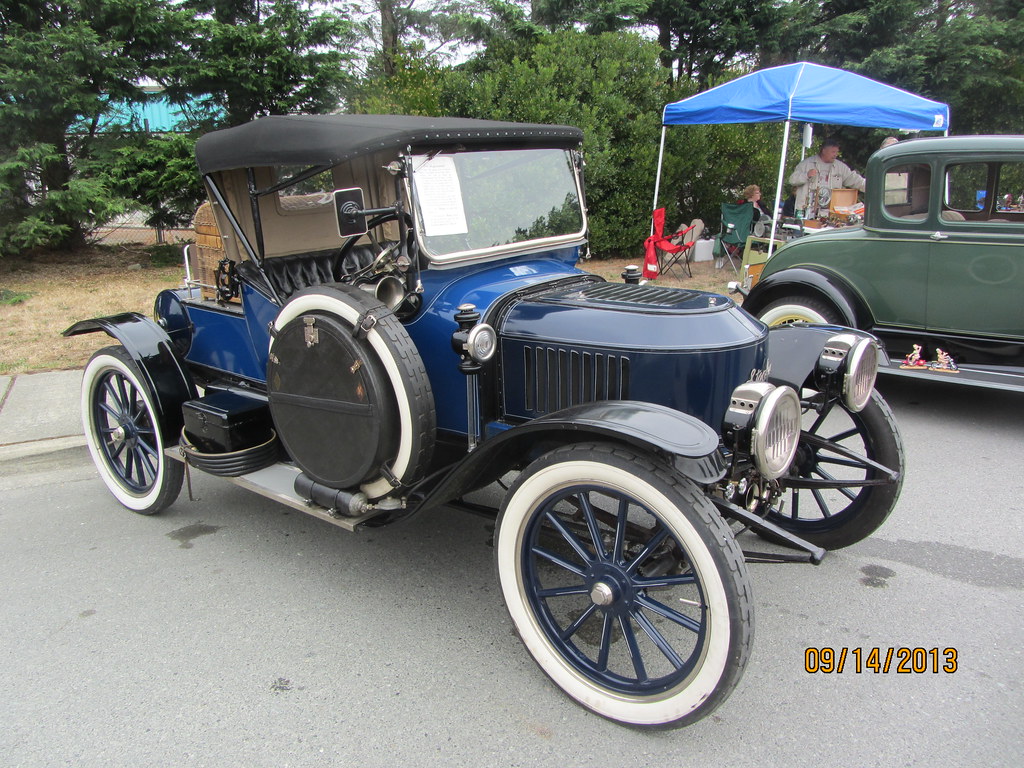
On January 27, 1904, William K. Vanderbilt Jr. drove a 90-horsepower Mercedes through the measured mile in 39 seconds - 92.3 mph - setting a recognized world land speed record. The run came fifteen days after Henry Ford had set a competing record on frozen Lake St. Clair in Michigan. One record on a frozen Midwestern lake, one on a Florida beach in January sunshine. The beach won on every front page.
At the same 1904 meet, Glenn Curtiss rode a two-cylinder machine to an American motorcycle record of 67.36 mph. That record stood for seven years. Curtiss was then a bicycle and motorcycle manufacturer from Hammondsport, New York. His performance on the Ormond sand was the first chapter of a career arc that would eventually make him a founding rival of the Wright brothers in American aviation.
The Ormond Garage followed for the 1905 season, built by the Flagler East Coast Hotel Company as a purpose-built service facility - the first of its kind in American motorsport, predating Indianapolis Motor Speedway's Gasoline Alley by several years. Also in 1905, American Mutoscope and Biograph Studios sent cameraman G.W. Bitzer to film the races. Bitzer later became D.W. Griffith's principal cinematographer, shooting "The Birth of a Nation" and much of Griffith's major work. The techniques he developed capturing fast-moving vehicles on the Ormond sand - the framing, the anticipation of motion - were genuinely new. The argument that Ormond Beach is also where sports broadcasting began is a serious one. What Bitzer did there was document competitive athletic performance for a mass audience, which is the definition of the form.
1906: Fred Marriott and the Stanley Rocket
The Stanley brothers - Freelan and Francis - had been building steam automobiles in Massachusetts since 1897. Steam power was not unusual for early cars; it offered advantages over gasoline engines of the period, particularly in immediate torque and smooth power delivery. What they built for the 1906 Ormond meet was a machine designed around a single purpose.
The Stanley Rocket was three feet wide, sixteen feet long, and weighed 1,600 pounds. It was shaped like a torpedo, the body nearly enclosing the boiler, with Marriott lying almost flat inside a cockpit so narrow his shoulders barely fit. The steam pressure fed an engine generating power comparable to what a racing gasoline car of the period produced, but with none of the mechanical complexity that caused gasoline engines to fail at high speeds.
The Stanley Rocket was the first machine to carry a human being faster than two miles per minute - a threshold that, before January 26, 1906, had belonged only to imagination.
Marriott ran the measured mile in 28.2 seconds. The official figure was 127.659 mph. The Dewar Trophy - awarded by the Royal Automobile Club for the most noteworthy automotive achievement of the year - went to Marriott and the Stanley brothers. For a public whose frame of reference for speed was a galloping horse, the number was close to incomprehensible. The steam record stood for four years and has never been beaten by another steam-powered vehicle on a public course.
1907: The Crash That Closed the Era
Marriott returned to Ormond Beach in 1907 to break his own record. The Stanleys had modified the Rocket for higher speed. Witness accounts and later estimates vary on the speed at the moment of impact; most period sources put the figure around 150 mph, though Marriott later recalled approaching 200 mph - the specific figure remains disputed among historians.
The disaster was not simply a tragic accident. It was a demonstration of how far improvised engineering had been pushed past its own foundations. The Rocket had no roll protection, no safety restraint, no crush structure, and no aerodynamic analysis beyond what the brothers could observe. At extreme speed, any surface imperfection becomes a launch ramp. The torpedo shape that helped at 127 mph generated lift at higher speeds that no one had calculated for - because the mathematics of high-speed aerodynamics was not yet a field.
The 1907 crash ended the Ormond-Daytona beach as a venue for outright land speed records. The cars had grown faster than the surface, faster than the engineering science available to contain them safely, and faster than anyone's ability to predict what would happen next.
The Long Thread: From Ormond Beach to NASCAR and Beyond
The engineering argument for Curtiss runs deeper than biography. He set an unofficial world land speed record of 136.36 mph at Ormond Beach on January 24, 1907, on a V-8 engine of his own design - faster than any land vehicle until 1911, and a motorcycle record that stood until 1930. But the significance is not the numbers. Building machines fast enough for Ormond required solving a specific problem: keeping an engine running reliably at sustained high output, not just reaching a peak and surviving. That is the same engineering problem early aircraft engines posed. Curtiss arrived at the Wright brothers' competitive territory carrying solutions he had worked out on Florida sand - the beach was, functionally, an involuntary test bed for the engine discipline that powered American aviation.
Bill France Sr. is the second thread. France moved to Daytona Beach in 1934 - one county south, the same coast - helped lay out the first beach-road racing course in 1936, promoted races there from 1938 onward, and founded NASCAR on February 21, 1948. The AAA-sanctioned 1903 Ormond meet and the 1948 NASCAR founding are 45 years apart and linked by an unbroken institutional culture of organized beach racing on this coast. Visitors who leave thinking the racing history is ancient and disconnected from modern motorsport are missing the actual story.
Bitzer's significance at Ormond is not that a famous cinematographer happened to start there. It is that Ormond created the problem his career then solved. Shooting machines moving at 90 or 127 mph required new technique - the operator had to anticipate where a subject would be, not react to where it was. That lead-and-follow approach, forced by the physics of the beach, became foundational to how motion pictures handle moving subjects. The earliest sports films exist because Biograph Studios saw commercial value in documented speed. The techniques those films required became standard cinematographic practice.
Visiting Birthplace of Speed Park
The physical site today sits at the intersection of A1A and Granada Boulevard in Ormond Beach. The park is free and open daily; check current hours through the City of Ormond Beach or at the site before you go, as seasonal schedules apply. Parking is across Granada Boulevard at Granada Plaza.
What the Replica Garage Contains
The replica garage was dedicated on March 28, 2013 - exactly 110 years after the first race. Scale models of the Bullet No. 1 and the Pirate anchor the exhibit, representing the two machines that ran the first sanctioned mile in 1903. Interpretive panels cover the full racing history. The structure is built on the footprint of the original Ormond Garage - the facility that burned in 1976, taking with it antique automobiles local residents had stored there as a community museum. The loss was both historical and immediate for the people who lived through it.
The Motor Racing Heritage Association runs open-house events at the replica garage; the most recent was in late August 2025. These events provide access to informed volunteers who can speak in depth about specific cars and records - they are the best way to see the exhibit with meaningful context. Check the association's current schedule before planning your visit.
How to Build a Full Day
- Arrive at Birthplace of Speed Park before 9 a.m. - the site is least crowded in the early morning and the beach light is better for photographs.
- Walk the beach at low tide from the ADA-accessible ramp. At low tide you are on the actual surface where the records were set - the same hard pack that supported the Stanley Rocket.
- Walk or drive north to The Casements for a guided tour of Rockefeller's former winter home. Together, the two sites give the complete picture of what the Hotel Ormond world actually was.
- Continue north on A1A into the Ormond Scenic Loop, a 22-mile circuit through hammock and marsh that makes the Gilded Age concentration of wealth and speed at its south end more striking by contrast.
Key Record Runs at Ormond Beach
| Year | Driver / Machine | Speed | Significance |
|---|---|---|---|
| 1903 | Winton / Bullet | ~48 mph | First AAA-sanctioned U.S. speed trial |
| 1904 | Vanderbilt / Mercedes | 92.3 mph | World land speed record; national front pages |
| 1904 | Curtiss / two-cylinder motorcycle | 67.36 mph | American motorcycle record; stood seven years |
| 1906 | Marriott / Stanley Rocket | 127.659 mph | World record; first two miles per minute; Dewar Trophy |
| 1907 | Curtiss / V-8 motorcycle | 136.36 mph | Fastest land vehicle in the world until 1911 |
Frequently Asked Questions
Was the racing at Ormond Beach or Daytona Beach?
The original AAA-sanctioned meets from 1903 through 1907 ran on the beach at Ormond Beach. Daytona Beach's racing history began in 1936 when Bill France Sr. helped lay out a beach-road course there - a different section of coast and a different format from the outright speed trials at Ormond. Visitors planning to see Birthplace of Speed Park should note that the site is in Ormond Beach, at A1A and Granada Boulevard, not in Daytona Beach.
Can I visit the replica garage interior, or is it only viewable from outside?
The Motor Racing Heritage Association holds open-house events at the replica garage where the interior - including the scale models of the Bullet and the Pirate - is accessible. The most recent event was in August 2025. Check the association's current schedule before visiting, since those events are the best way to see the models up close and speak with people who can explain the specific cars in detail.