The St. Augustine Alligator Farm Zoological Park sits on Anastasia Boulevard on the same barrier island Henry Flagler's railway corridor reached in the late nineteenth century. It opened on May 20, 1893 - more than 130 years ago - placing it among Florida's oldest continuously operating tourist attractions. Most visitor guides present it as a reptile exhibit with a zip line attached. What they omit: the farm holds the world's only complete collection of all 24 living crocodilian species; its constructed swamp serves as an active federal monitoring site for a threatened bird species; and the original location where it opened is now several hundred yards beneath the Atlantic Ocean. Those three facts alone justify more than a quick summary.
Anastasia Island and the Flagler-Era Tourism Corridor
Anastasia Island sits just east of downtown St. Augustine, separated from it by the Matanzas River. By the 1880s and 1890s, Henry Flagler's railway system had turned St. Augustine into the preferred winter destination for wealthy northeastern travelers, and the island directly across the water was a natural extension of that tourism geography. A narrow-gauge railway - the Anastasia Island Tram - ran the length of the island, carrying visitors south to the beach at the island's tip. That tram terminus, called South Beach, was where the alligator farm began.
The farm today stands roughly two miles north of that original location, next to the St. Augustine Lighthouse, on a ten-acre inland site it has occupied since 1920. Its address on Anastasia Boulevard still places it squarely within the same Gilded Age tourism corridor - Anastasia State Park begins less than half a mile away, the lighthouse is visible from the grounds. For anyone following the heritage route that runs through Flagler, St. Johns, and Volusia counties, the alligator farm is not a detour. It is one of the last surviving institutions that was already old when the automobile replaced the railway as the visitor's primary vehicle.
The 1893 Founding: Alligators as a Marketing Strategy
A Souvenir Shop at the Tram Terminus
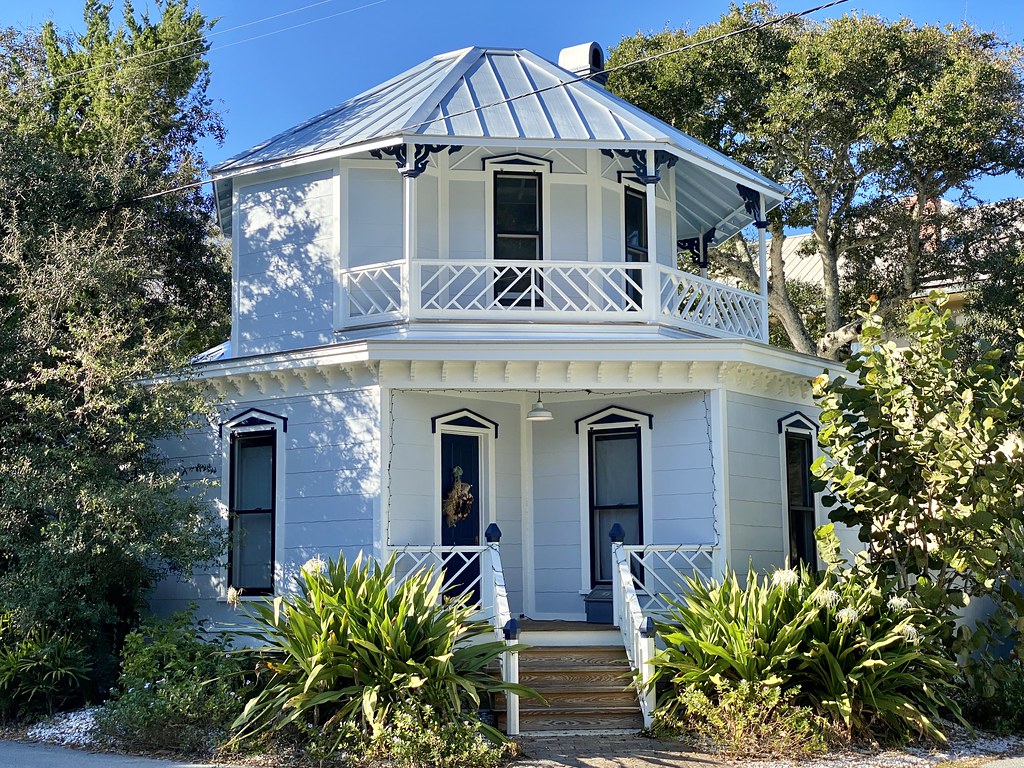
George Reddington and Felix Fire opened their operation at South Beach on May 20, 1893, with a commercially straightforward purpose. Beachgoers stepping off the tram needed something to do before getting back on. Reddington and Fire had a souvenir shop. The alligators were out front not because anyone was running a zoo, but because an alligator in a pen attracts a crowd, and a crowd near a souvenir shop spends money. This was a standard Gilded Age attraction strategy: put the curiosity at the entrance, work on the commerce inside.
What neither founder could have anticipated was that the alligators would become the institution, not the merchandise. As Florida's tourism infrastructure grew - pushed by Flagler's hotels and the class of wealthy traveler his railways brought south - the farm expanded alongside it. By the early twentieth century it had pens, demonstrations, and a paying audience that came specifically for the animals. The souvenir gambit had produced a zoo, and the zoo had outgrown its origins entirely.
Storm, Relocation, and a Site That No Longer Exists
The 1920 Nor'easter
In September 1920 a nor'easter of sufficient force destroyed the Anastasia Island Tram's railway tracks. Without the tram, the South Beach location lost its reason to function as a tourist draw - the visitors had no reliable way to get there. The owners moved the farm two miles north to the inland ten-acre parcel near the lighthouse, the site it has occupied ever since.
The Ocean Took the Rest
The relocation proved permanent in a way that goes beyond commercial logic. Chronic beach erosion on the Atlantic side of Anastasia Island continued for decades after the farm departed. The entire South Beach area - the tram terminus, the original grounds, the spot where Reddington and Fire opened their shop in 1893 - eroded away completely. The original site is now several hundred yards beneath the Atlantic Ocean. There is no marker to find, no foundation to photograph. The ground itself is gone.
This is not a small footnote. It means the institution's origin point has been physically erased by the same ocean that defines the island. When the owners moved north after the 1920 storm, they inadvertently saved the farm from the fate of its own birthplace. The lighthouse neighborhood turned out to be the more permanent address.
The World's Only Complete Crocodilian Collection
All 24 Species
In 1993 - the farm's hundredth anniversary year - it became the first institution in the world to house all 24 living crocodilian species. No other zoo, aquarium, or wildlife facility holds the complete set. The 24 species span four distinct groups:
- True crocodiles - including saltwater, Nile, mugger, and American crocodile species, the largest and most globally distributed family
- Alligators - the American alligator and the critically endangered Chinese alligator, the two surviving members of the alligatorid subfamily
- Caimans - black, broad-snouted, spectacled, and dwarf caiman species native to Central and South America
- Gharial and false gharial - the most visually distinct crocodilians, identifiable by their narrow fish-adapted snouts, found only in South and Southeast Asia
Assembling and maintaining this collection required decades of acquisition, international partnerships, and the specialized habitat infrastructure to keep animals with radically different requirements - from tropical South American river systems to Southeast Asian estuaries - alive and healthy side by side. The farm has held AZA accreditation since 1989, meeting the Association of Zoos and Aquariums' standards for animal care, veterinary programs, and conservation engagement across all those species through regular review cycles.
Gomek
The crocodile most responsible for cementing the farm's international reputation arrived the same year as its AZA accreditation. Gomek, a saltwater crocodile caught in Papua New Guinea in 1968, came to St. Augustine in 1989. He died on March 6, 1997, at approximately 70 years old, measuring 17 feet 9 inches and weighing 1,896 pounds - dimensions that place him among the largest saltwater crocodiles ever held in captivity.
What made Gomek exceptional was not only his size. Adult saltwater crocodiles caught in the wild are typically too dangerous for sustained exhibit situations - their aggression at scale makes keeper management extremely difficult. Gomek's decades in human care before his St. Augustine years had produced a tractability unusual for an animal of his dimensions. He could be worked with by keepers in ways that a comparably sized wild-caught animal rarely permits. His presence from 1989 until his death gave the farm's crocodilian program credibility with the zoological community at exactly the moment the institution was building toward its centennial and its complete-collection distinction. A cast of his skull remains on display, an adequate indication of scale for visitors who arrive a generation after he was alive.
Maximo
The farm's current largest resident is Maximo, a saltwater crocodile who arrived from Australia in 2008. He exceeds 15 feet in length and weighs more than 1,200 pounds. Saltwater crocodiles are the largest living reptiles and continue adding mass throughout their lives; Maximo is not close to the upper bound of what his species can reach. Feeding demonstrations on a published daily schedule draw the same crowds that gathered for Gomek a generation earlier, for the same reason - watching a predator of that scale interact with food is not something easily replicated anywhere else.
Why Wading Birds Nest Above Alligators
The Raccoon-Deterrence Mechanism
The rookery at the Alligator Farm looks, to a first-time visitor, like a paradox. Hundreds of wading birds choose to nest directly above enclosures full of large reptiles when quieter locations exist throughout Florida. The explanation is not coincidence and not some unusual interspecies tolerance. It is a documented ecological relationship that makes the birds' behavior completely rational once it is understood.
Raccoons are among the most destructive nest predators in the Florida landscape. A single raccoon reaching an active nesting colony can destroy eggs and kill chicks across dozens of nests in one night, climbing nest trees with ease. Alligators present no threat to birds overhead - they are aquatic predators oriented toward prey at water level - but their presence in the water beneath a nest tree makes that tree unreachable by any climbing mammal. The birds are trading proximity to one predator for protection from a more consistently dangerous one. From a nesting-success standpoint, the alligator pond is among the safest sites available in the region.
The farm built the rookery swamp in 1999 and introduced alligators to it that year. Wood storks began nesting there the same season the alligators arrived. The protective relationship established itself without delay, and the colony has grown in both size and species diversity since.
Species Present in the Colony
- Wood storks
- Roseate spoonbills
- Great egrets
- Snowy egrets
- Tricolored herons
- Little blue herons
- Cattle egrets
Peak viewing runs from April through July. The boardwalk above the rookery swamp puts visitors at canopy level during the season, with active nests directly overhead.
| Species | Federal status | Nesting at farm since | Peak season |
|---|---|---|---|
| Wood stork | Threatened | 1999 | April-June |
| Roseate spoonbill | Not federally listed | Around 2010 | April-July |
| Great egret | Not federally listed | Long established | March-June |
| Tricolored heron | Not federally listed | Long established | April-July |
| Snowy egret | Not federally listed | Long established | April-June |
| Little blue heron | Not federally listed | Long established | April-July |
The Conservation Numbers Behind the Spectacle
Federal Monitoring and What It Requires
Wood storks were listed as Endangered by the U.S. Fish and Wildlife Service for decades before the agency downlisted them to Threatened on June 30, 2014. That downlisting reflected documented population gains built on consistent nest monitoring at active sites across the birds' Florida breeding range. The Alligator Farm submits its annual wood stork nest counts to federal authorities each season. This is a formal monitoring obligation tied to threatened-species management, not a voluntary publicity exercise. The counts feed directly into the ongoing federal assessment of whether wood stork recovery is holding.
In the 2023-2024 nesting season, the farm recorded 124 wood stork nests and 208 wood stork chicks - among the highest figures in the rookery's history. Each season's data becomes part of the permanent federal record for the species.
The Roseate Spoonbill Range Expansion
Roseate spoonbills began nesting at the farm around 2010, and their presence there carries a significance that visitor guides consistently miss. St. Augustine sits north of the range where roseate spoonbills typically nest in Florida. The birds nesting at the Alligator Farm represent a documented northward range expansion - a biogeographic shift that has accumulated data points over roughly fifteen years. The 2023-2024 season saw 74 roseate spoonbill nests at the farm, growth from a handful of pairs to dozens since nesting first began. The pink birds that photograph well above the alligator ponds are not simply aesthetically striking; they are a live record of a population expanding its territory, with the farm's rookery as one of the most accessible northern sites where that expansion can be observed.
The rookery at the Alligator Farm is not an accidental congregation of wildlife. It is a purpose-built conservation site that feeds real data into federal threatened-species management - a function that most visitors walking the boardwalk in April never know they are witnessing.
Exhibits, Demonstrations, and Crocodile Crossing
The Crocodilian Exhibits
The park routes visitors through the collection in a way that moves across species systematically. The main saltwater crocodile habitat anchors the route, with Maximo as the dominant presence. Surrounding enclosures hold the full range of species - from dwarf caimans to the gharial, whose extreme narrow snout makes it unmistakable. The Oasis on the Nile exhibit focuses on Nile crocodiles and associated African species, extending the narrative beyond Florida and North America. Fossil Discoveries is an interpretive area placing living crocodilians in their evolutionary context - a lineage that predates and outlasted the dinosaurs, now represented in full at a single address on Anastasia Island.
Live feeding demonstrations run on a published daily schedule. Maximo's feedings draw the largest crowds. Arriving for the first scheduled feeding of the day typically means shorter waits than midday sessions.
Crocodile Crossing
Crocodile Crossing is a zip line and ropes course that opened in 2011. It covers seven acres of the park on 17 zip lines and more than 50 obstacles, most of them suspended directly over open crocodilian enclosures. It is a physically demanding experience that takes genuine time - not a quick add-on. The view it delivers of the animals below is different in character from anything available from ground-level pathways. Height, weight, and age requirements apply; check the farm's current guidelines before expecting young children to participate, as these conditions are set by the farm and subject to change.
Planning Your Visit
Getting There and Logistics
The farm is on Anastasia Boulevard on Anastasia Island, reached by the Bridge of Lions from downtown St. Augustine or by road from the south. Parking is available on site. The farm charges admission and maintains its own hours schedule; check the official Alligator Farm website for current prices and hours directly - these figures change and are better sourced there than from any secondary guide.
The park is open year-round. Florida summer heat between June and August makes early morning the most comfortable window for the outdoor portions of the visit. If the rookery is a priority, plan your visit between April and July - outside that window the swamp holds alligators but no active nesting birds.
Accessibility and What to Bring
Main pathways are paved and wheelchair accessible. The rookery boardwalk accommodates standard mobility aids. Crocodile Crossing requires physical climbing ability and is not accessible to mobility-aid users. The park is largely open to full Florida sun - shade is intermittent across the grounds.
- Binoculars - necessary for rookery viewing, where nests are overhead at significant height above the boardwalk
- Camera with telephoto reach - nesting spoonbills and storks reward a longer lens; smartphone cameras will produce distant shots
- Water and sun protection - the combination of heat and an open layout makes both more important than visitors typically anticipate
- Two to three hours minimum - the crocodilian collection and rookery together justify that; Crocodile Crossing adds an additional hour to two depending on pace and queues
Combining Sites on a Single Day
The alligator farm, the St. Augustine Lighthouse, and Anastasia State Park form a natural single-day circuit. A logical order of operations:
- Arrive at the Alligator Farm at opening - the coolest part of the day, when morning feeding demonstrations typically begin and animal activity in the crocodilian exhibits is highest.
- After the farm, walk or drive to the St. Augustine Lighthouse, less than half a mile north - tours run on a continuous schedule and the adjacent museum covers the maritime and navigation history of the inlet.
- From the lighthouse, head to Anastasia State Park, a short drive south along the boulevard - the park's Atlantic beach and dune system give the island circuit a natural endpoint before returning north.
- Return north along Anastasia Boulevard in the late afternoon, passing through the historic district toward the Bridge of Lions and downtown St. Augustine.
Frequently Asked Questions
Is the Alligator Farm really the only place in the world with all 24 crocodilian species?
Yes. Since its centennial year of 1993 the St. Augustine Alligator Farm has been the only institution in the world to hold all 24 living crocodilian species simultaneously. No other zoo or aquarium has replicated this, which requires not only acquiring rare animals but maintaining specialized habitat for species from widely different ecosystems across decades. The AZA accreditation the farm has held since 1989 is part of what makes long-term management of this collection possible.
How does Crocodile Crossing work and is it appropriate for families with young children?
Crocodile Crossing is a seven-acre zip line and ropes course with 17 zip lines and more than 50 obstacles suspended directly above live crocodilian enclosures - a physically demanding experience that typically takes an hour or more to complete. The farm sets its own age, height, and weight requirements, which can change season to season; check the official website before planning around it with children who might not qualify. The main crocodilian exhibits and rookery boardwalk are suitable for all ages and are entirely separate from the zip course.