The Casements sits on the west bank of the Halifax River in Ormond Beach, charges nothing to enter, and holds more American history per square foot than most sites that charge twenty dollars at the door. It anchors the southern end of the 98-mile Heritage Crossroads corridor - the chain of heritage sites running through Volusia, Flagler, and St. Johns counties - and most travelers drive past it entirely. That's worth understanding, because the story here isn't simply "Rockefeller bought a winter house." It runs from Henry Flagler's railroad strategy to a Gilded Age speed record, from the world's wealthiest man handing out dimes on a morning walk to a building that spent 37 years as a school, a rest home, and a hotel annex before a city decided it was worth saving. The full story takes about two hours to walk through. It rewards both.
How Henry Flagler Put Ormond Beach on the Map
Before Rockefeller ever set foot in Ormond Beach, Henry Flagler had already turned it into the kind of place Rockefeller would want to visit. In 1890, Flagler purchased the Ormond Hotel - at the time a modest 75-room resort on the Halifax River - and began a transformation that had less to do with luxury and more to do with logistics.
Flagler expanded the hotel to 400 rooms and added amenities that set it apart from other southern resorts of the era:
- Mechanical elevators, then a genuine novelty in Florida hospitality
- A saltwater swimming pool
- A dedicated Florida East Coast Railway bridge running from the mainland straight to the hotel's entrance
- Direct rail service connecting northeastern cities to the hotel's door without a single transfer
The railway bridge was the decisive move. Flagler's Florida East Coast Railway already ran down the peninsula, and by extending a spur directly to the hotel he collapsed the friction of travel for wealthy northeasterners who expected convenience. The Ormond Hotel became a winter fixture for the American industrial class - not because the climate was unique, but because Flagler had made getting there effortless.
His second investment proved even more far-reaching. In 1904, Flagler built the Ormond Garage to service race cars competing in the Ormond Beach speed trials, where the hard-packed Atlantic beach served as a natural straightaway. That garage became the first dedicated 'gasoline alley' in American motorsport - Indianapolis Motor Speedway didn't open until five years later. The trials drew competitors and spectators from across the country. In 1907, motorcycle pioneer Glenn Hammond Curtiss set a land speed record on Ormond Beach that generated international coverage, a feat visible from the hotel's upper floors to anyone watching. Rockefeller was wintering at the Ormond Hotel by then. He saw all of it.
Rockefeller Arrives: From Hotel Guest to Homeowner
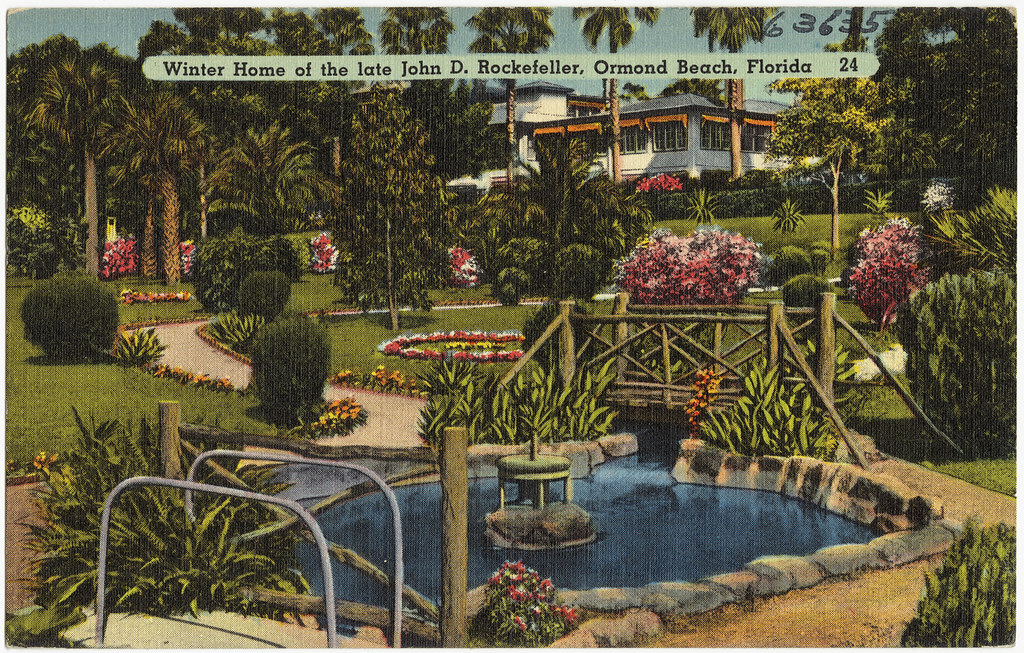
Rockefeller spent years as a guest at the Ormond Hotel before he became a property owner. Flagler's resort was exactly the kind of environment he'd have found comfortable - warm, well-managed, frequented by people in his social circle. The arrangement ended when the hotel raised its rates. Rockefeller's response was characteristically unsentimental: he looked across Riverside Drive, found a house that suited him, and moved out for good.
In 1918 he purchased The Casements, the riverfront home built five years earlier by Reverend Dr. Harwood Huntington. He was 79 years old. He wintered here for the remaining 19 years of his life.
What surprised people who knew him only through newspaper accounts of Standard Oil was how he lived in Ormond Beach. He walked. Real town walks, not perfunctory strolls - the kind that took him past houses and shops and into the daily life of a small Florida community. He carried shiny new dimes and handed them to children, neighbors, and household staff he encountered on his route. The custom became so well known that people arranged themselves along his regular paths. The town took to calling him 'Neighbor John,' a nickname that would have baffled anyone who associated him only with trust-busting headlines.
The Architecture: Windows, River, and Climate Logic
Huntington built The Casements in 1913, and the name is structural, not decorative. The large hand-cut casement-style windows lining the main living areas were a deliberate response to the Florida climate. Before mechanical cooling, a house of this scale needed cross-ventilation to stay livable through Florida's spring and warm winters. Huntington sited and oriented the windows to pull river breezes from the Halifax through the interior, making the water outside a functional part of the building's climate system rather than just scenery.
Several features define the exterior and floor plan:
- Shingle Style exterior typical of American resort architecture from the late 19th and early 20th centuries
- Wide covered porches extending the usable living space into the river air
- A horizontal massing that settles into the riverbank rather than asserting itself above it
- Approximately 9,000 square feet arranged around comfort and social use, not formal display
- Riverside siting on the west bank of the Halifax, positioning the building at the southern anchor of what is now the Heritage Crossroads corridor
The floor plan reads, in retrospect, as a working document of how prosperous Americans used domestic space in the early 20th century. Ground-floor rooms handled daily life and receiving guests. The upstairs was private. It was a home that Rockefeller used as a home - walked through every day, gave parties in, and died in. That continuity of purpose is visible in the proportions of every room.
What's Inside: Three Rooms in Detail
The Casements operates today as a community cultural center. Its three permanent exhibit spaces represent three distinct histories that converge in an unlikely Florida river house. Each is worth real attention.
The Rockefeller Period Room
The ground-floor period room presents artifacts and furnishings from Rockefeller's years of residency. The pieces connect directly to the decades he lived here rather than to the Standard Oil era or to the mythology that formed around his name. For anyone who's read Rockefeller through business or industrial history, the domestic scale of the room recalibrates the image: this was a man who lived in a house, walked through a town, and handed out dimes. The room makes that concrete.
The Boy Scout Historical Exhibit
The origin of this exhibit is almost never mentioned in travel coverage, which is a genuine omission. It began as an Eagle Scout project by Ormond Beach resident John Slaughter. Troop 403 has maintained and expanded it since, and what started as a local initiative has grown into one of the largest Boy Scout collections in the American Southeast. The scope covers the breadth of the organization's history:
- Merit badge patches tracing decades of program evolution
- Jamboree neckerchiefs from multiple national gatherings
- Handbooks showing how the program's guidance changed across generations
- Uniforms from different periods of the organization's history
For visitors with a scouting background, this room carries a different emotional weight than the rest of the house. Even without that background, the collection functions as a detailed social history of American youth organizations across the 20th century.
The Hungarian Folk Art Gallery
The upper-floor gallery is the least-known of the three spaces and arguably the most visually striking. The Ormond Beach Hungarian community donated the collection - a fact that most travel writing reduces to a sentence without explaining why it's here. Hungarian emigrants established a real community in the Ormond Beach area during the mid-20th century, and the gallery represents a deliberate act of cultural preservation by that community, not an arbitrary donation to a historic house.
The pieces include hand-embroidered textiles produced through techniques that take months per item, hand-painted ceramics in specific regional folk traditions, and traditional festival costumes worn at Hungarian folk celebrations. Nothing is generic. Each piece carries a regional identity, and the context panels explain the traditions behind the objects. Budget more time here than you expect to need.
Rockefeller's Daily Rhythms at The Casements
Rockefeller golfed at the Oceanside Country Club and maintained the walking routine that made him a neighborhood fixture. But the most historically resonant gatherings at The Casements were the Christmas parties he hosted for his Gilded Age contemporaries. These brought together men whose names anchored American industrial history: Henry Ford, Harvey Firestone, Thomas Edison. All three are recorded as guests at the adjacent Ormond Hotel. The convergence of the oil baron, the automaker, the tire manufacturer, and the inventor in a small Florida river town - repeatedly, over many years - doesn't appear in the standard biography of any of them, but it happened here, at dinners Rockefeller hosted.
The Casements was not a retreat from American industrial history. It was a winter meeting place for the men who made it.
Rockefeller died in his upstairs bedroom on May 23, 1937, at age 97. He had long stated publicly that he intended to live to 100. He died about six weeks before his 98th birthday, falling nearly three years short of his goal. That gap between the ambition and the outcome - stated publicly, missed by a significant margin - is the kind of human detail that stays with you after standing in the room where it happened.
37 Years of Reinvention: 1937 to 1974
Nearly every travel account of The Casements moves directly from Rockefeller's death to the city's purchase, skipping 37 years that explain why the building survived at all. The house passed through three distinct institutional phases before Ormond Beach acquired it:
- School and junior college: The property operated as the Fairmont-Casements School and Junior College. The building's size made it adaptable to an educational use without structural transformation, and this phase gave the property an ongoing purpose at a moment when many comparable Gilded Age residences were being demolished or left vacant.
- Rest home: A religious organization operated the building as a rest home. The institutional continuity - a property that kept being used for something, rather than sitting idle - is likely what kept it in reasonable condition through the mid-20th century.
- Hotel annex: The Casements served as auxiliary accommodation for the old Ormond Hotel next door, returning the building to something close to its original relationship with the hotel that had drawn Rockefeller to Ormond Beach in the first place.
The building was listed on the National Register of Historic Places in 1973. The City of Ormond Beach purchased it the following year, funding a full restoration through a federal Economic Development Administration grant under the Local Public Works Act. The building reopened in 1979 as the community cultural center it remains today. The 37-year gap between Rockefeller's death and the city's acquisition is a story about institutional luck as much as anything else - the house survived because it kept being useful to someone.
Practical Visitor Guide
Hours and Admission
Admission is free for individual visitors. The building is open Monday through Friday from 8 a.m. to 5 p.m. and on Saturday from 8 a.m. to noon - the shorter Saturday window catches many visitors off guard, so plan accordingly. Group tours request a small per-person donation; confirm current details on the City of Ormond Beach's official website before organizing a group visit. Hours can shift around holidays and city events, so a quick check before driving is worth the 30 seconds.
The Self-Guided Tour App
A free self-guided audio tour app is available through the official website and works on any smartphone. No major travel article about The Casements mentions this. Most visitors arrive without it, which means they're reading posted text in rooms where narrated context would add considerably more. Download it before you leave your car - or ideally before you leave home, in case the parking lot signal is unreliable.
Parking
Free off-street parking occupies a dedicated lot directly adjacent to the building. Additional on-street parking is available on both sides of the Riverside Drive bridge. Neither requires payment or a permit.
Rockefeller Gardens Park and River Path
The city-maintained Rockefeller Gardens Park runs along the riverfront immediately adjacent to The Casements. On the first Friday of each month it hosts free outdoor movie screenings - worth planning around if your trip dates allow it. A pedestrian path under the Riverside Drive bridge connects the park to Cassen Park and Bailey's Riverfront Gardens on the Halifax's opposite bank, giving a natural walking extension to any visit.
Pairing The Casements with the Heritage Crossroads Corridor
The Casements sits at the corridor's southern end, which makes it a natural starting point for a day moving north through the heritage sites. Three destinations lie within 20 miles and connect directly to the history you've just walked through.
| Stop | Distance | Type | Admission |
|---|---|---|---|
| Birthplace of Speed Park / Ormond Garage | Under 1 mile north | Outdoor historic site | Free |
| Tomoka State Park | Approx. 3 miles north | Paddling, trails, natural history | State park fee - check FloridaStateParks.org for current rate |
| Bulow Creek State Park | Approx. 12 miles north | Old-growth hammock, hiking | Free |
| Bulow Plantation Ruins Historic State Park | Approx. 15 miles north | Historic ruins, Seminole War site | State park fee - check FloridaStateParks.org for current rate |
Half-Day Itinerary
Arrive at The Casements at opening time with the tour app already downloaded. Walk all three exhibit rooms - budget 90 minutes to do it properly. Then walk north on Riverside Drive to the Birthplace of Speed Park and the original Ormond Garage site. This is the place where Rockefeller, as an Ormond Hotel guest, would have watched Glenn Curtiss set his land speed record. The round trip from The Casements covers under a mile. Finish with a walk through Rockefeller Gardens Park along the river before driving on.
Full-Day Itinerary
Follow the half-day route, then drive north to Tomoka State Park for a paddle through the coastal estuary or a trail walk through the hammock. If the calendar cooperates, continue to Bulow Creek State Park to see the Fairchild Oak - one of the oldest living oaks in Florida - and the creek-side trails. Add the Bulow Plantation Ruins for historical contrast: the plantation was burned during the Second Seminole War in 1836, leaving only foundations and a sugar mill chimney standing. The juxtaposition is stark. In the morning you stood in a room where the wealthiest man in America hosted Christmas parties with Henry Ford. By afternoon you're standing in the ruins of a plantation destroyed by war 80 years before Rockefeller ever arrived. The corridor holds both stories without resolving them.
Frequently Asked Questions
Is admission to The Casements really free?
Yes - general admission costs nothing for individual visitors. Group tours request a small per-person donation; the current figure is listed on the City of Ormond Beach's official website. Parking in the adjacent lot is also free, and the self-guided tour app is free to download.
How long should I plan for a visit?
Sixty to ninety minutes covers all three exhibit rooms at a reasonable pace. Using the self-guided audio app adds depth and pushes the realistic time toward 90 minutes rather than 60. Add another 20 to 30 minutes if you walk through Rockefeller Gardens Park and the river path to Cassen Park on the far bank.
Why does the building have windows in its name?
The original owner, Reverend Dr. Harwood Huntington, designed the 1913 house around large hand-cut casement-style windows positioned specifically for cross-ventilation in the Florida climate. The name came from that functional design choice, not from any decorative intent. Rockefeller kept the name when he purchased the property in 1918 and it has stayed ever since.
What happened to The Casements between Rockefeller's death and today?
The building went through three distinct institutional phases over 37 years: a school and junior college, a rest home operated by a religious organization, and an annex for the adjacent Ormond Hotel. The City of Ormond Beach purchased it in 1974, completed a federally funded restoration, and reopened it as a cultural center in 1979. This mid-century history is rarely covered in travel writing but explains why the building survived.
Is the Hungarian Folk Art gallery connected to local history, or is it a random donation?
It's directly connected to local history. The Ormond Beach Hungarian community established a real presence in the area during the mid-20th century, and the gallery was donated by that community as a deliberate preservation effort - not as a generic gift to a historic house. The embroidered textiles, painted ceramics, and festival costumes represent specific regional folk traditions, and the context panels in the gallery explain the cultural background behind each type of object.
Can I visit The Casements and the Birthplace of Speed in the same trip?
Yes, and you should - the two sites are less than a mile apart and tell directly connected stories. The Ormond Garage where Flagler built America's first gasoline alley in 1904 is within easy walking distance of The Casements, and the land speed record set on the beach in 1907 was visible from the Ormond Hotel where Rockefeller was already wintering. Visiting both in sequence, on foot, makes the causal chain from Flagler's investment to Rockefeller's arrival tangible in a way that reading about it doesn't.